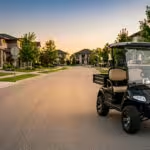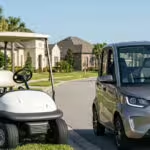
Navigating the shift from a full-sized commuter vehicle to a neighborhood electric vehicle (NEV) is a major lifestyle upgrade for residents in gated subdivisions. It reduces wear and tear on your primary vehicle, cuts down on fuel costs, and offers unmatched convenience for short community trips.
Allerdings ist die Annahme, dass das Fahren innerhalb Ihres Bezirks gesetzlich verboten ist, eine enorme Belastung. Es ist wichtig, die Gesetze für Golfwagen zu verstehen, bevor Sie Reifen auf den Bürgersteig bringen.
Viele Hausbesitzer glauben fälschlicherweise, dass sie sich von der staatlichen und kommunalen Aufsicht entbinden, wenn sie sich von den Hauptstraßen der Stadt fernhalten. Die betriebliche Realität vor Ort sieht völlig anders aus.
Local police departments and property management boards actively enforce golf cart laws to ensure community safety and mitigate insurance risks. Let’s break down the exact operational guidelines, mechanical requirements, and legal frameworks you need to navigate residential driving successfully.
Inhaltsverzeichnis
Was ist das neue Golfwagengesetz in Florida?
Florida frequently serves as the regulatory benchmark for community vehicle legislation nationwide due to its high density of retirement and master-planned communities. The state recently implemented strict oversight, specifically targeting underage drivers and holding parents accountable for neighborhood joyrides.
Under the updated regulations, operating a cart on any public roadway requires a valid learner’s permit or a full driver’s license. You can no longer hand the keys to an unlicensed teenager to run down to the community pool.
This legislative update fundamentally shifted how communities view golf cart laws statewide. It forces property owners to treat these small vehicles with the exact same respect and legal caution as traditional automobiles.
Eine sehr detaillierte Aufschlüsselung dieser spezifischen staatlichen Vorschriften, Fahrzeugklassifizierungen und jüngsten gesetzlichen Änderungen finden Sie in unserer umfassenden Übersicht Florida Golf Cart Laws & Street Legal Guide.
Compliance with modern golf cart laws often means upgrading your standard factory model. Converting a basic neighborhood cruiser to a fully compliant Low-Speed Vehicle (LSV) requires specific safety additions, which we will detail further down in the compliance section.
Gelten Golfwagengesetze für Privatstraßen?
The short answer is yes, though the enforcement mechanisms vary depending on your community’s specific infrastructure. Residents often operate under the dangerous assumption that Startseiteowners Association (HOA) maintained streets are entirely exempt from state-level vehicle rules.
Sie gehen davon aus, dass die Standardgesetze für Golfwagen nicht gelten, da die Straßen privat finanziert und eingezäunt sind. Dies ist rechtlich unrichtig und ein schneller Weg zu einer schwerwiegenden Haftung im Falle eines Unfalls.
Auch wenn in Ihrer privaten Sackgasse kein Staatspolizist sitzt und das Radar überwacht, behalten die Strafverfolgungsbehörden die uneingeschränkte Zuständigkeit für schwere Straftaten. Rücksichtsloses Fahren, Gefährdung von Kindern usw Fahren unter Alkoholeinfluss (DUI) gelten auf Privatgrundstücken genauso streng wie auf öffentlichen Autobahnen.
If a collision occurs resulting in property damage or physical injury, the legal framework of Golf cart laws in residential neighborhoods and gated communities takes immediate precedence during the police investigation and insurance claims process.
Darüber hinaus ist die Herstellung dieser Fahrzeuge bundesweit reguliert. Laut der Nationale Behörde für Straßenverkehrssicherheit (NHTSA), low-speed vehicles must comply with Federal Motor Vehicle Safety Standard No. 500 (FMVSS 500). This dictates basic structural integrity, braking distances, and safety equipment regardless of where the vehicle ultimately operates.
Sie müssen beim Fahren in Wohngebieten mit der gleichen Vorsicht, dem gleichen Situationsbewusstsein und den gleichen defensiven Fahrtechniken umgehen wie beim Navigieren an einer stark befahrenen Gewerbekreuzung.
Müssen sich Golfwagen an die Verkehrsregeln halten?
Absolut. Wenn Sie den Bürgersteig mit Fußgängern, Hundeführern, Landschaftsgärtnern und schweren Lieferwagen teilen, sind Sie Teil eines aktiven, fließenden Verkehrsökosystems.
Fahrer müssen an allen Stoppschildern vollständig anhalten, auf Zebrastreifen Fußgängern Vorfahrt gewähren und vor dem Manövrieren geeignete elektronische Blinker oder eindeutige Handsignale verwenden.
Ignoring these basic traffic control devices is not just a violation of golf cart laws; it creates severe personal liability risks. If you cause a collision by rolling through a neighborhood stop sign, you are fully at fault, and your insurance provider will process the claim as an at-fault moving violation.
Adhering to strict golf cart safety regulations protects you from unnecessary litigation and keeps the community safe. Simple operational practices like maintaining a strict 15 mph speed limit and avoiding sharp turns that could cause a rollover are mandatory for responsible fleet management at home.
It is also crucial to understand your vehicle’s mechanical limitations. A fully loaded cart carrying four adults can weigh over 1,200 pounds. Standard mechanical drum brakes take significantly longer to stop this mass compared to the hydraulic disc brakes found on standard cars. Traffic anticipation is essential.
Der HOA-Faktor: Wenn Gemeinschaftsregeln Vorrang vor staatlichen Vorschriften haben
Your Startseiteowners Association or property management board possesses absolute authority over vehicle operation within the community gates. Through deed restrictions, they can impose operational rules that are far stricter than your local municipal codes.
Selbst wenn Ihre örtliche Gemeinde die Golfwagen-Gesetze sehr locker angeht, können die Beschränkungen Ihrer Eigentumsurkunde völlig andere Regeln vorschreiben, denen Sie beim Kauf Ihres Hauses gesetzlich zugestimmt haben.
HOAs frequently restrict operating hours to daylight only, mandate specific parking areas (such as requiring the cart to be parked inside the garage overnight rather than the driveway), and strictly regulate vehicle colors or modifications to maintain aesthetic uniformity.
Furthermore, many communities require internal golf cart registration decals to be displayed prominently on the cowl or windshield. This allows security personnel to identify non-residents or track down residents who are driving recklessly.
Before purchasing a new vehicle or attempting a lithium battery upgrade, always cross-reference your county statutes with the HOA master deed. Violating HOA rules can result in escalating daily fines, the revocation of your community gate transponder privileges, or even a lien against your property.
Grundlegende Compliance: Registrierung, Versicherung und Upgrades
Operating a vehicle legally in a residential zone requires administrative diligence and proactive mechanical maintenance. Understanding basic golf cart licensing requirements is the first step; if your community roads are dedicated to the county, you unequivocally need a valid driver’s license to get behind the wheel.
Financially, relying on standard homeowners insurance to cover a vehicle accident is a massive oversight. Proper golf cart insurance requirements dictate securing a specialized policy designed specifically for low-speed vehicles.
Mechanically, meeting full street legal golf cart requirements involves significant, standardized upgrades. You cannot simply bolt on a few aftermarket parts. You must install a DOT-approved AS1 or AS4 safety glass windshield (complete with a wiper blade), Vom Verkehrsministerium zertifizierte Reifen, Reflexreflektoren, Feststellbremsen und eine 17-stellige Fahrzeugidentifikationsnummer (VIN).
Ensuring your vehicle is fully equipped and mechanically sound keeps you aligned with local golf cart laws. It also vastly improves your nighttime visibility and overall structural safety when navigating alongside heavier passenger trucks.
Schließlich ist die strikte Einhaltung der Altersbeschränkungen für Golfwagen in fast allen Gerichtsbarkeiten und Gemeindesatzungen nicht verhandelbar.
Allowing underage, unlicensed teens to transport their friends around the neighborhood is an unacceptable liability risk. This is the fastest way to face steep citations and vehicle impoundment under current golf cart laws.
A lack of awareness regarding golf cart laws can lead to severe financial penalties and compromised safety for your neighbors. Ignorance of the municipal statutes or your HOA’s covenants is never accepted as a valid legal defense in civil or traffic court.
FAQ
Darf ich meinen Einkaufswagen nachts legal in meiner Nachbarschaft fahren?
It depends entirely on your vehicle’s specific lighting package and local ordinances. Night driving strictly requires functional headlights, brake lights, illuminated taillights, and turn signals. Many golf cart laws prohibit dusk-to-dawn operation completely unless the vehicle is officially registered, titled, and insured as a fully street-legal LSV.
Benötige ich ein staatlich ausgestelltes Nummernschild für meinen Gemeinschaftswagen?
If the roads within your subdivision are public right-of-ways owned by the city or county, you typically need official state DMV registration, a title, and a visible license plate mounted on the rear. Always verify the specific golf cart laws in your jurisdiction; strictly private, gated communities may only require an HOA-issued identification decal.
Sind Lithiumbatterie-Upgrades für Einkaufswagen in der Nachbarschaft legal?
Yes, upgrading from heavy lead-acid batteries to lithium is generally legal and highly recommended for better range and reduced vehicle weight. However, ensure that any modifications to the motor controller during the upgrade do not increase the vehicle’s top speed beyond the legal limits (typically 15-20 mph for standard carts, and 25 mph for LSVs).