
You see them everywhere in master-planned communities from Florida to California: sleek, quiet, open-air machines humming down the road. But for many owners, there is a looming legal question that only surfaces when a blue light appears in the rearview mirror or an insurance claim is denied. Is your ride a simple golf cart, or is it a true Neighborhood Electric Vehicle?
The distinction isn’t just about semantics or how much you paid. It is a fundamental difference in legal classification, safety engineering, and where you are allowed to drive. If you are a buyer looking for a 25 mph electric vehicle that can legally navigate public streets, buying a glorified golf cart is an expensive mistake.
Inhaltsverzeichnis
Was definiert eigentlich ein Nachbarschafts-Elektrofahrzeug nach Bundesgesetz?
In the United States, a Neighborhood Electric Vehicle is a specific category of transport. While the term is often used interchangeably with “golf cart” by salesmen, the federal government sees things differently. According to the National Highway Traffic Safety Administration (NHTSA), an NEV falls under the broader umbrella of Low-Speed Vehicles (LSVs).
To be classified as a Neighborhood Electric Vehicle, the machine must be a four-wheeled motor vehicle whose top speed is greater than 20 mph but not more than 25 mph. This speed range is the “legal sweet spot.” If it goes slower than 20 mph, it is generally considered a golf cart (equipment). If it is designed to go faster than 25 mph, it must meet much more stringent full-scale passenger car safety standards.
Understanding Street legal neighborhood electric vehicle laws starts with recognizing that an NEV is a “motor vehicle” in the eyes of the law, whereas a golf cart is often classified as “recreational equipment.”
Die 25 MPH-Linie: Warum Geschwindigkeit für den DMV wichtig ist
For many buyers, speed is the primary motivator. You want to keep up with local traffic on 35 mph residential roads. However, there is a hard technical ceiling. A Neighborhood Electric Vehicle is federally capped at 25 mph because that is the limit for the safety testing it undergoes.
When conducting a NEV vs golf cart comparison, look at the speedometer. Most standard golf carts are governed at 14.9 mph. Attempting to “mod” a golf cart to reach 25 mph does not magically turn it into an NEV. In fact, it often makes the vehicle illegal and unsafe, as the braking and steering systems were never designed for those velocities.
A true 25 mph electric vehicle comes from the factory with a Manufacturer’s Certificate of Origin (MCO) that explicitly states the vehicle meets federal LSV standards. Without this document, your local DMV will likely refuse to issue a title or license plate.
FMVSS 500: Die Sicherheitsstandards, die Sie nicht ignorieren können
Why is one allowed on the road and the other restricted to the fairway? The answer lies in Federal Motor Vehicle Safety Standard No. 500 (49 CFR 571.500). This is the “bible” for Street legal neighborhood electric vehicle laws.
Jedes Nachbarschaftselektrofahrzeug, das für den Einsatz auf öffentlichen Straßen hergestellt wird, muss per Gesetz mit bestimmten Sicherheitsmerkmalen ausgestattet sein. Dabei handelt es sich nicht um optionales Zubehör; Es handelt sich um Bundesanforderungen:
- Scheinwerfer und Rückleuchten
- Blinker vorn und hinten
- Bremsleuchten (Bremslichter)
- Reflektoren (ein roter auf jeder Seite/hinten)
- Rückspiegel (Innen- und Fahrerseite)
- Feststellbremse
- Windschutzscheibe (entspricht den Standards AS-1 oder AS-4 für erdölbasierte Verglasungen)
- 17-stellige VIN (Fahrzeugidentifikationsnummer)
- Sicherheitsgurte (Typ 1 oder Typ 2)
Wenn in Ihrem Fahrzeug auch nur eines davon fehlt, handelt es sich nicht um ein konformes Nachbarschafts-Elektrofahrzeug. Den vollständigen Gesetzestext dieser Anforderungen finden Sie unter Government Publishing Office (CFR Titel 49).
Der 17-stellige Fahrgestellnummer: Der ultimative Beweis für die Straßenzulassung
The most reliable way to tell if you own a Neighborhood Electric Vehicle or just a fancy golf cart is to look for the VIN. A standard golf cart has a serial number. A street-legal NEV has a 17-digit Vehicle Identification Number, exactly like a Ford or a Tesla.
Dieser 17-stellige Code ist der Schlüssel zu allem. Es ermöglicht Ihnen:
- Registrieren Sie das Fahrzeug beim Department of Motor Vehicles Ihres Staates.
- Besorgen Sie sich ein Nummernschild, das für das Fahren auf öffentlichen Straßen obligatorisch ist.
- Sichere Kfz-Versicherung, die für LSVs oft gesetzlich vorgeschrieben ist, für einfache Karren jedoch nicht immer verfügbar ist.
When researching how to source high-quality Cr12MoV components for high-stress machinery, engineers look for certifications. Similarly, a savvy buyer looks for the VIN plate. If a dealer tells you a cart is “street-ready” but it doesn’t have a 17-digit VIN, walk away. You are looking at a golf cart that may be illegal the moment its tires touch public asphalt.
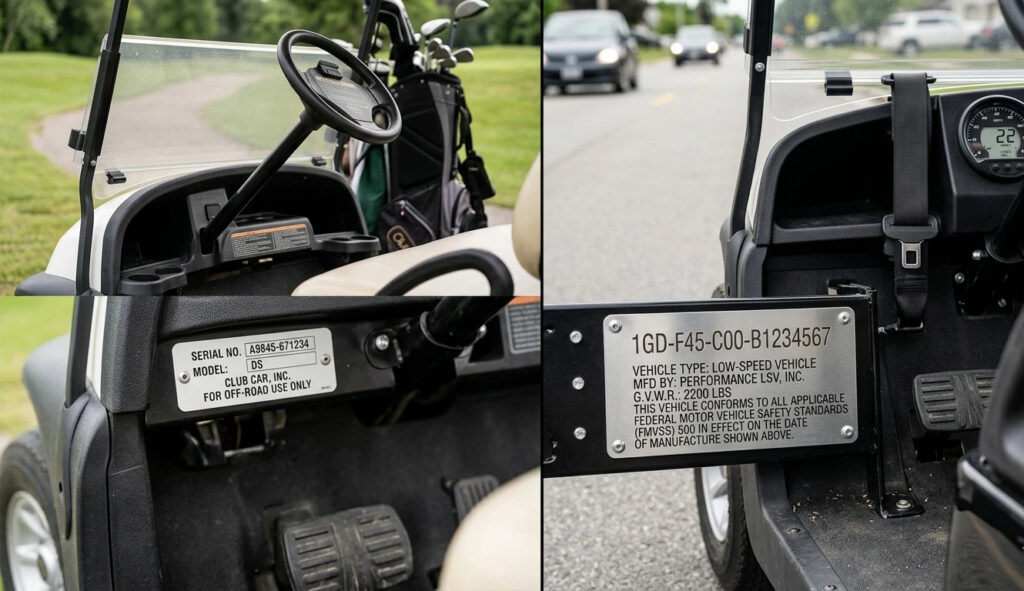
NEV vs Golfwagen: Erkundung der Leistungslücke
Über die gesetzlichen Bestimmungen hinaus gibt es eine enorme technische Lücke. Da ein Neighborhood Electric Vehicle für eine Geschwindigkeit von 25 Meilen pro Stunde auf Straßen ausgelegt ist, die auch von SUVs genutzt werden, ist das Fahrgestell in der Regel robuster.
In a NEV vs golf cart showdown, you will notice the NEV usually features better suspension, often automotive-style A-arms, and superior braking—frequently four-wheel hydraulic disc brakes. Standard golf carts often rely on simple mechanical drum brakes on the rear wheels only. If you are driving at 25 mph and a car pulls out in front of you, those four-wheel discs aren’t just a luxury; they are a necessity.
Furthermore, the Cr12MoV properties found in industrial tool steel ensure longevity in high-stress environments. Likewise, the materials used in NEV drivetrains are designed for constant road use rather than the intermittent stop-and-go of a golf course.
Navigieren in den lokalen Straßenzulassungsgesetzen für Elektrofahrzeuge in der Nachbarschaft
Während das Bundesgesetz (FMVSS 500) vorschreibt, wie ein NEV sein muss gebautLandes- und lokale Gesetze bestimmen, wo es sein kann angetrieben. Im Allgemeinen gestatten die meisten Staaten den Betrieb eines Neighborhood Electric Vehicle auf Straßen, auf denen die Geschwindigkeitsbegrenzung 35 Meilen pro Stunde oder weniger beträgt.
However, some local municipalities are stricter. For example, some beach towns in Florida have specific “LSV-only” zones, while others may ban them from certain high-traffic corridors even if the limit is 30 mph. Always check your local city ordinances. The “street legal” tag from a manufacturer means the vehicle dürfen Sie müssen zwar registriert sein, erhalten aber keinen „Drive Anywhere“-Pass.
Eine bundesstaatliche Aufschlüsselung darüber, wie diese Fahrzeuge auf lokalen Straßen reguliert werden, finden Sie beim Insurance Institute for Highway Safety (IIHS).
Die Versicherungsrealität: Schutz Ihrer Investition
Another area where the Neighborhood Electric Vehicle differs from the golf cart is insurance. Because an NEV is a registered motor vehicle, you cannot simply add it to your homeowner’s insurance as a “recreational toy” and expect full coverage for a road accident.
Most states require a Neighborhood Electric Vehicle to carry Personal Injury Protection (PIP) and Property Damage Liability (PDL). If you are involved in a collision with a standard car, having an automotive-grade insurance policy is the only thing protecting you from personal liability. Many insurance carriers have specific “Low-Speed Vehicle” policies designed specifically for this category.
Warum Geschwindigkeitssüchtige sich niemals mit einem Einkaufswagen zufrieden geben sollten
For the buyer who wants performance, the Neighborhood Electric Vehicle is the only logical choice. Trying to “overclock” a golf cart is a recipe for mechanical failure and legal headaches. A factory-built LSV/NEV offers a level of stability and power that a cart cannot match.
Whether it is the upgraded AC motor controllers or the high-capacity lithium battery packs, a Neighborhood Electric Vehicle is engineered to maintain 25 mph even with four passengers and a trunk full of groceries. It is the difference between a tool built for a specific job and a toy pushed beyond its limits.
Abschluss
Bei der Wahl zwischen einem Golfwagen und einem Nachbarschafts-Elektrofahrzeug kommt es auf eines an: Ihren Verwendungszweck. Wenn Sie lediglich vorhaben, über ein Fairway oder Ihr eigenes Privatgrundstück zu kriechen, reicht ein Golfwagen aus.
But if your lifestyle involves public roads, school drop-offs, or trips to the local market, the Neighborhood Electric Vehicle is the only choice that offers legal protection and automotive safety. Don’t be fooled by “street-ready” marketing. Look for the VIN, check the 25 mph limit, and ensure the vehicle meets the FMVSS 500 standard.
Wenn Sie in ein echtes Nachbarschafts-Elektrofahrzeug investieren, kaufen Sie nicht nur eine Fahrt – Sie kaufen die Freiheit, die Straße legal und sicher zu nutzen.
Still debating whether a standard golf cart or a street-legal LSV is right for your needs? Our technical team specializes in navigating the complexities of NEV regulations and can help you select a vehicle that is 100% compliant with federal safety standards.
FAQ
Ist ein Neighborhood Electric Vehicle dasselbe wie ein LSV?
Ja. Rechtlich gesehen sind sie gleich. NEV ist die von Verbrauchern gebräuchliche Bezeichnung, während LSV (Low-Speed Vehicle) der vom Verkehrsministerium verwendete Begriff ist.
Kann ich einen Golfwagen auf der Straße fahren, wenn ich Blinker anbaue?
Nicht unbedingt. Sofern das Fahrzeug nicht über eine 17-stellige Fahrgestellnummer und ein Ursprungszertifikat des Herstellers verfügt, aus dem hervorgeht, dass es FMVSS 500 erfüllt, wird es durch das Hinzufügen von Lichtern nicht zu einem legalen Elektrofahrzeug für die Nachbarschaft.
Brauche ich einen Führerschein für ein NEV?
Ja. Da es sich um ein zugelassenes Kraftfahrzeug handelt, benötigen Sie einen gültigen Führerschein, um es auf öffentlichen Straßen fahren zu dürfen.
Was ist die Höchstgeschwindigkeit eines Nachbarschafts-Elektrofahrzeugs?
Laut Bundesgesetz muss die Geschwindigkeit auf 25 Meilen pro Stunde begrenzt sein.
Kann ein NEV auf die Autobahn fahren?
Nein. Sie sind auf Autobahnen und anderen Straßen mit einer Geschwindigkeitsbegrenzung von normalerweise mehr als 35 oder 45 Meilen pro Stunde (je nach Bundesstaat) strengstens verboten.