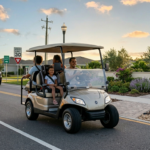
Neighborhood dynamics have evolved. Today, electric and gas-powered carts are no longer restricted to the fairways; they have become the primary mode of transportation for school drop-offs, grocery runs, and neighborhood socializing. For many families, handing the keys to a teenager seems like a harmless, convenient rite of passage.
However, this convenience often crashes head-on with local legislation. The legal boundary between a harmless joyride and a traffic violation is incredibly thin. Property managers and parents are increasingly asking the same critical questions regarding legality, safety, and liability.
Is a Golf Cart License mandatory? At what age can someone legally take the wheel? The answers are rarely straightforward, heavily depending on your state, your neighborhood’s legal classification, and the physical specifications of your vehicle. Securing the proper Golf Cart License knowledge is not just about avoiding citations; it is about protecting your family’s financial future and ensuring community safety.
Inhaltsverzeichnis
Benötigen Sie einen Führerschein, um einen Golfwagen zu fahren?
The most common question we encounter is a direct one: Do you need a driver’s license to drive a golf cart? The short answer is: it depends entirely on where you are driving and how your vehicle is classified by the federal and state government.
Traditionally, if a vehicle is operated exclusively on a private golf course or strictly designated off-road trails, a standard driver’s license or a specific Golf Cart License is rarely mandated by state law. However, the moment the vehicle’s tires touch a public street, a publicly maintained road, or a highway crossing, the legal landscape shifts dramatically.
Under federal guidelines set by the National Highway Traffic Safety Administration (NHTSA), standard carts are capable of speeds less than 20 mph. While the federal government leaves standard cart regulation to local jurisdictions, most states require the operator to hold a valid driver’s license, a restricted permit, or a state-issued Golf Cart License to operate them on public roads.
Wenn ein Fahrzeug so umgebaut wird, dass es schneller als 20 Meilen pro Stunde fährt (und so zu einem Langsamfahrfahrzeug wird), ist die Anforderung eines gültigen Führerscheins in fast allen 50 Bundesstaaten zwingend erforderlich.
Altersgrenze für Golfwagen: Die Unterschiede zwischen den einzelnen Bundesstaaten
One of the biggest misconceptions is that age requirements do not apply outside of standard automobiles. In reality, the age limit for golf carts is strictly enforced by state transportation departments, and these laws are constantly being updated to address safety concerns.
Understanding underage golf cart driving laws requires looking at specific state codes. A perfect example of this evolving legislation is Florida. Recently, Florida passed House Bill 949 (effective October 2023), which aggressively tightened the loopholes surrounding underage drivers.
Before this bill, teens as young as 14 could legally drive a cart on certain roads without a learner’s permit or a Golf Cart License. Today, the law dictates that anyone under the age of 18 must possess a valid learner’s permit or driver’s license. If they are 18 or older, they must have a valid form of government-issued ID.
Let’s look at the minimum age to drive a golf cart in Florida vs. California. While Florida requires a permit (effectively setting the age at 15 with a permit), California’s Vehicle Code (CVC Section 21115) dictates that operators on public roads must possess a valid driver’s license, effectively setting the minimum age at 16. In both instances, operating without the proper Golf Cart License or standard state license is a direct violation of the motor vehicle code.
Referenz: Analyse des Gesetzentwurfs des Senats von Florida für HB 949; Informationen zur kalifornischen Gesetzgebung, Abschnitt Fahrzeugcode 21115.
Gated Communities: Der Mythos „Privateigentum“.
A highly searched query by homeowners is: Can a 14 year old drive a golf cart in a gated community? There is a dangerous assumption that living behind a gate exempts residents from state traffic laws. Many parents assume that a Golf Cart License is unnecessary as long as the vehicle never leaves the subdivision. This is often legally incorrect.
The distinction relies on who owns and maintains the roads. If the roads within the gated community are owned and maintained by the county or city, state traffic laws apply in full. Therefore, unlicensed minors driving on them are breaking the law.
Even if the roads are truly private (owned by the Startseiteowners Association), the HOA is legally obligated to establish community golf cart rules. For liability reasons, the vast majority of HOAs mirror state laws in their bylaws. If an HOA allows unlicensed 14-year-olds to drive and an accident occurs, the HOA could face severe negligence lawsuits. Consequently, security patrols in modern developments still enforce Golf Cart License and age-limit checks to mitigate community risk.
Gesetzliche Anforderungen und LSVs für Golfwagenstraßen
Wenn wir über die Lizenzierung sprechen, müssen wir uns mit dem Fahrzeug selbst befassen. Es gibt einen massiven rechtlichen Unterschied zwischen einem Standardwagen und einem Low-Speed-Vehicle (LSV).
Low-speed vehicle (LSV) regulations dictate that any four-wheeled vehicle capable of speeds between 20 mph and 25 mph is classified as a motor vehicle. According to the NHTSA (49 CFR Part 571.500), an LSV must be equipped with specific safety features, including headlamps, taillights, seat belts, a DOT-approved windshield, turn signals, and a Vehicle Identification Number (VIN).
Because an LSV is a registered motor vehicle, driving one makes holding a valid driver’s license or Golf Cart License an absolute requirement. You cannot legally operate an LSV with just a learner’s permit in many jurisdictions without a licensed adult present.
Wenn Sie planen, Ihren Standardwagen so aufzurüsten, dass er legal auf Gemeindestraßen mit Geschwindigkeitsbegrenzungen von bis zu 35 Meilen pro Stunde fahren kann, müssen Sie den komplexen Umbauprozess bewältigen. Alle treffen Straßenrechtliche Anforderungen für Golfwagen ist der erste obligatorische Schritt, bevor Sie das Fahrzeug registrieren, Nummernschilder erwerben und sicherstellen können, dass Ihr Golfwagen-Führerschein Ihre Fahrzeugklasse abdeckt.
Die Versicherungslücke: Schutz Ihres Familienvermögens
Wenn Eltern die Schlüssel übergeben, denken sie selten an eine Versicherung, bis die Katastrophe eintritt. Eine häufig gestellte Frage lautet: Deckt die Hausratversicherung Unfälle mit Golfwagen ab?
In the vast majority of cases, the answer is a resounding no. Standard homeowners insurance policies typically exclude coverage for motorized vehicles operated off the physical premises of your property. If your teenager crashes into a parked car or injures a pedestrian three streets over, your home insurance will likely deny the claim.
Your Golf Cart License status directly affects your insurance validity. If an unlicensed minor causes property damage, the insurance provider can void the coverage entirely, leaving the parents personally responsible for medical bills and property replacement.
Für Einwohner bestimmter Bundesstaaten sind die Versicherungsvorschriften äußerst streng. Um genau zu verstehen, welche Deckung gesetzlich vorgeschrieben ist, um ein massives finanzielles Risiko zu vermeiden, lesen Sie unsere umfassende Übersicht Leitfaden zu den LSV-Versicherungsanforderungen für Florida.
Elternhaftung und rechtliche Konsequenzen
Wir müssen der Sicherheit von Golfwagen für Minderjährige Priorität einräumen, nicht nur aus Gründen des körperlichen Wohlbefindens, sondern auch aus rechtlichen Gründen. Die Folgen des Fahrens eines Golfwagens ohne Führerschein gehen weit über einen einfachen Schlag aufs Handgelenk hinaus.
If law enforcement catches an underage, unlicensed driver on a public road, the repercussions usually fall on the parents. Parents can be cited for allowing an unauthorized minor to operate a motor vehicle. Furthermore, driving without a proper Golf Cart License can result in the vehicle being impounded.
In the event of an accident involving bodily injury, the parents face “negligent entrustment” liability. This means the injured party can sue the parents’ personal estate—including their home and savings—because the parents knowingly allowed an unqualified minor to operate a dangerous machine.
Abschluss
The evolution of neighborhood transportation requires a proactive approach to the law. While the breeze and convenience of open-air driving are undeniable, they must be balanced with strict adherence to local statutes. From understanding the difference between private HOA roads and public streets to confirming your Golf Cart License status and securing the proper insurance, taking these legal steps ensures that your family’s driving experience remains safe, enjoyable, and completely lawful.
FAQ
Benötigen Sie eine Versicherung, wenn Sie nur in Ihrer Nachbarschaft fahren?
If your neighborhood roads are public, yes. If they are private, state law might not mandate it for standard carts, but your HOA likely does. Furthermore, without dedicated insurance, you are personally liable for any damage or injury caused.
Was passiert, wenn ein Minderjähriger beim Fahren eines LSV ohne Führerschein erwischt wird?
Because an LSV is legally a motor vehicle, the minor can be charged with driving without a license. This can delay their ability to get a standard driver’s license in the future, and the parents can face significant fines.
Reicht ein normaler Führerschein oder benötige ich einen separaten Golf-Cart-Führerschein?
In almost all states, a valid standard state driver’s license is completely sufficient to operate a street-legal cart or LSV. Very few jurisdictions require a separate, specifically designated license just for carts, provided you hold a standard driver’s license.
Kann ich meinen Standard-Warenkorb so ändern, dass er schneller geht, ohne ihn zu registrieren?
No. By federal definition, if you modify the speed controller or motor to allow the vehicle to exceed 20 mph, it legally becomes an LSV. It must then meet all street-legal safety requirements, be registered with the DMV, and be driven by a licensed operator.