
You know the feeling: you’re at the base of a moderate incline with a cart full of gear or family, and your vehicle groans to a crawl. Most owners assume the batteries are dying or the motor is weak. In reality, the culprit is often the factory-installed “brains” of the machine. The stock golf cart speed controller is typically engineered for the lowest common denominator—prioritizing liability and battery protection over raw performance and uphill grunt.
For DIY enthusiasts looking to transform their ride from a neighborhood cruiser into a high-performance machine, understanding the golf cart speed controller is the first step. It is the gatekeeper of energy, determining exactly how much amperage reaches your motor and how that power is delivered through the throttle curve.
Inhaltsverzeichnis
Die Physik der Leistung: Warum Verstärker für das Drehmoment wichtig sind
To understand why a stock golf cart speed controller fails on hills, we have to look at the relationship between Amps and Torque. In a DC or AC electric motor system, torque is directly proportional to the current (Amperage) supplied. While voltage roughly equates to top speed, amperage provides the “muscle” to move weight.
Factory controllers are often limited to 225A or 250A. When you hit a hill, the motor demands more current to maintain its RPM. If the golf cart speed controller caps that current, your speed drops. Upgrading to a 400A or 500A unit doesn’t necessarily mean you’ll go faster on flat ground, but it means you won’t slow down when the terrain gets tough.
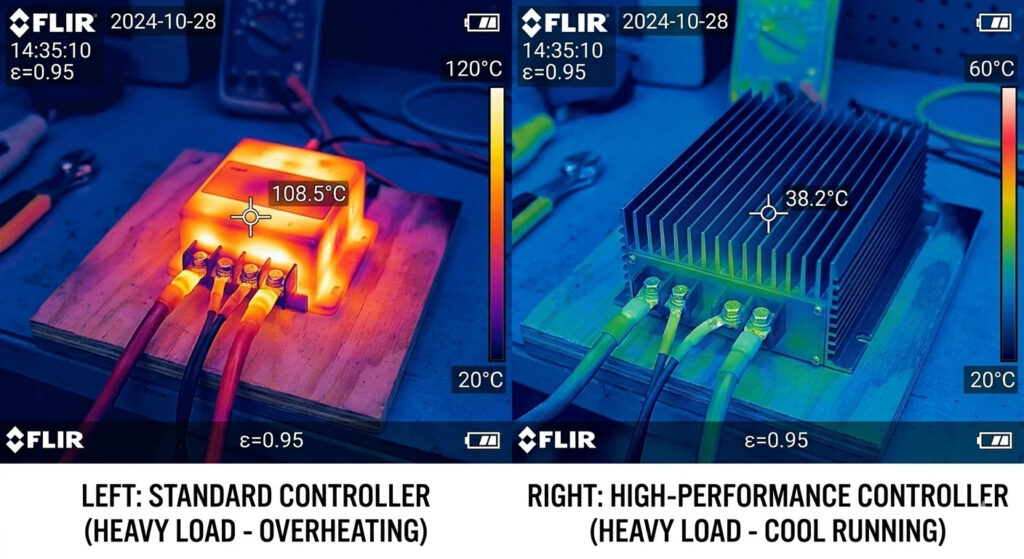
Wie im Electrical Engineering Portal des IEEE erwähnt, erfordert die Bewältigung hoher Ströme ein robustes Wärmemanagement, um die „Wärmereduzierung“ zu verhindern, die häufig bei billigeren Geräten auftritt. Sie können mehr darüber lesen Wärmemanagement in der Leistungselektronik über IEEE.
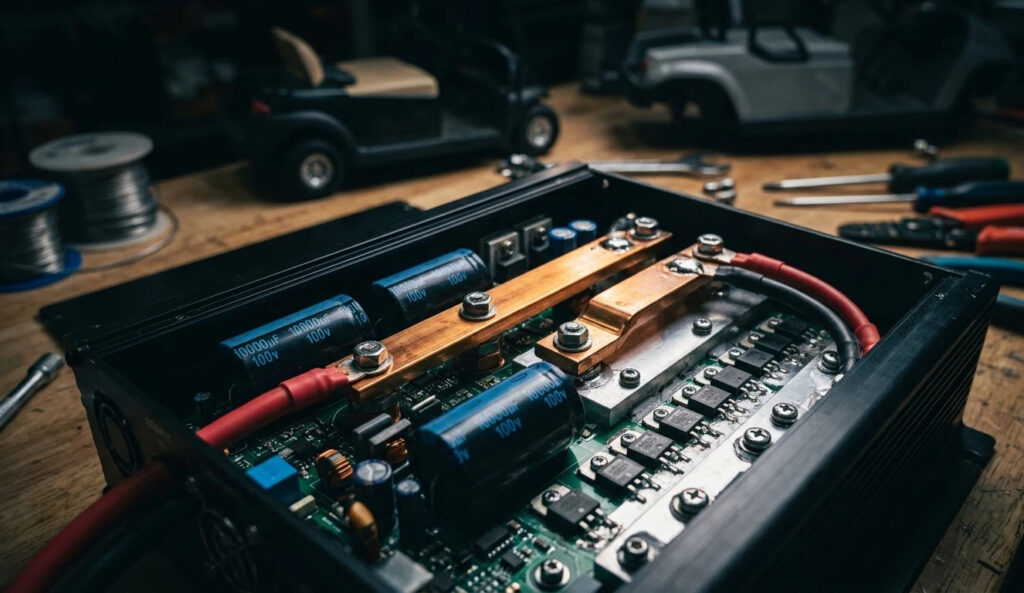
Synergie: Kopplung des Controllers mit einem Hochgeschwindigkeitsmotor-Upgrade
If your goal isn’t just climbing hills but also increasing your top-end velocity, you are likely looking at a high-speed motor upgrade. However, installing a high-speed motor without upgrading your golf cart speed controller is a recipe for disappointment.
A high-speed motor is wound differently to achieve higher RPMs, but these windings often require a higher “turn-on” current to reach their peak efficiency. If you stay with a stock golf cart speed controller, you might actually find that you lose low-end torque in exchange for a few extra MPH on flat pavement.
When you combine a high-speed motor upgrade with a programmable controller, you gain the ability to feed that hungry motor exactly what it needs at every point of the RPM range. This synergy ensures that you don’t just go fast—you get to that top speed quickly.
So programmieren Sie den Golfwagen-Controller für mehr Drehmoment
This is where the DIY magic happens. Most modern aftermarket units from brands like Alltrax or Navitas offer Bluetooth or USB interfaces. If you want to know how to program golf cart controller for more torque, you need to focus on three specific parameters:
1. Spitzenstrombegrenzung: Erhöhen Sie diesen Wert auf die maximale sichere Nennleistung Ihres Motors (häufig 400–500 A für kurze Stöße). Dies sorgt für den „Knack“, wenn Sie auf das Pedal treten.
2. Drosselklappen-Up-Rate: Dies bestimmt, wie schnell der Controller die Leistung hochfährt. Stellen Sie es zu hoch ein, und Sie werden einen Wheelie machen oder eine Achse brechen; Stellen Sie es genau richtig ein und Sie erhalten sofort eine Antwort.
3. Aktueller Boost: Einige Controller ermöglichen einen „Boost“-Modus, der speziell bei niedrigen Drehzahlen (0-500 U/min) zusätzliche Stromstärke liefert, was genau das ist, was Sie für das Anfahren am Berg benötigen.
Navigieren durch die gesetzliche Redline auf öffentlichen Straßen
Before you dial in your golf cart speed controller to hit 30 MPH, you must understand the legal landscape. In many jurisdictions, the moment a golf cart exceeds 20 MPH, it ceases to be a “golf cart” in the eyes of the law and becomes a Low-Speed Vehicle (LSV).
Upgrading your golf cart speed controller gives you the power to break these limits easily. However, operating a modified cart on public streets requires specific safety equipment like turn signals, mirrors, and often a VIN. For a deep dive into the regulations of driving a golf cart on public roads, including the distinction between standard carts and LSVs, check out this comprehensive guide on Gesetzliche Anforderungen für Golfwagen.
Smart builders often program their “Street Mode” to a hard cap of 19.9 MPH to stay within the legal “Golf Cart” definition while saving the “Off-Road Mode” for private property where they can utilize the full potential of their high-speed motor upgrade.
Der Einfluss von Hochleistungssteuerungen auf die Motorlebensdauer
In der Physik gibt es kein kostenloses Mittagessen. Wenn Sie einen Golfwagen-Geschwindigkeitsregler verwenden, um mehr Strom durch einen Motor zu leiten, erzeugen Sie Wärme. Dies wird als $I^2R$-Verlust (aktuelles Quadrat mal Widerstand) bezeichnet.
If you frequently utilize the “extreme” settings of your how to program golf cart controller for more torque session, you are subjecting the motor’s internal windings to higher temperatures. Over time, excessive heat breaks down the varnish insulation on the copper wires, leading to a short circuit and motor failure.
Um Ihre Investition zu schützen:
- Installieren Sie einen Temperatursensor: High-End-Controller können die Leistung drosseln, wenn der Motor zu heiß wird.
- Rüsten Sie Ihre Kabel auf: Ein 500-A-Golfwagen-Geschwindigkeitsregler ist nutzlos, wenn er durch winzige 6-Gauge-Werkskabel verstopft ist. Upgrade auf 2-Gauge- oder 4-Gauge-Schweißkabel.
- Belüftung: Stellen Sie sicher, dass der Kühlkörper des Controllers Zugang zur Luftzirkulation hat.
Hardware-Empfehlungen: Alltrax vs. Navitas vs. Curtis
Die Auswahl des richtigen Golfwagen-Geschwindigkeitsreglers hängt von Ihrem technischen Komfortniveau ab.
- Alltrax (Die Wahl des Experten): Bekannt für unglaublich tiefgründige PC-basierte Programmierung. Wenn Sie sich mit jedem Milliampere- und Gashebel befassen möchten, ist dies der Goldstandard.
- Navitas (Der benutzerfreundliche König): Bietet einen „On-The-Fly“ (OTF)-Programmierer – einen physischen Knopf, den Sie am Armaturenbrett montieren können, um Geschwindigkeit, Drehmoment und Rekuperationsbremsung in Echtzeit anzupassen.
- Curtis (Der OEM-Standard): Zuverlässig und robust, erfordert jedoch oft spezielle (und teure) Handheld-Programmierer, um Leistungsmodi freizuschalten.
Das Fazit
Upgrading your golf cart speed controller is the single most effective way to improve your vehicle’s drivability. By understanding how to program golf cart controller for more torque, you can tailor the machine to your specific environment—whether that’s a hilly golf course or a gated community.
Just remember: with great power comes the need for better cooling and a clear understanding of the law. Keep your heat in check, stay under the 20 MPH limit on public asphalt, and your upgraded cart will provide years of high-performance service.
FAQ
Wird mein Wagen mit einem 500-A-Controller schneller fahren?
Nicht unbedingt auf ebenem Boden. Es bietet mehr Drehmoment für Steigungen und Beschleunigung. Die Höchstgeschwindigkeit wird eher durch die Spannungs- und Motordrehzahlgrenzen bestimmt.
Kann ich meinen Originalmotor mit einem Hochleistungs-Golfwagen-Geschwindigkeitsregler verwenden?
Ja, aber Sie müssen vorsichtig sein. Wenn man über einen längeren Zeitraum 500 A in einen Standardmotor einspeist, der für 250 A ausgelegt ist, wird dieser irgendwann durchbrennen. Verwenden Sie die Programmierung des Controllers, um einen sicheren „Max Current“-Grenzwert festzulegen.
Reduziert ein höheres Drehmoment meine Batteriereichweite?
Ja. Für das Drehmoment ist eine Stromstärke erforderlich, und die Stromstärke ergibt sich aus der Batteriekapazität. Wenn Sie mit Ihrem neuen Hochgeschwindigkeitsmotor-Upgrade aggressiv fahren, müssen Sie mit einem Rückgang der Reichweite um 10–20 % rechnen.
Ist es schwierig, einen Aftermarket-Geschwindigkeitsregler für Golfwagen zu installieren?
Most modern kits are “plug and play” with specific wiring harnesses for Club Car, EZGO, and Yamaha. However, you should always disconnect your batteries and set the Tow/Run switch to “Tow” before starting.