When the temperature drops or the rainy season sets in, most golfers and neighborhood cruisers tend to park their vehicles. However, the right gear can transform your cart from a summer luxury into a year-round utility. Investing in high-quality Golf cart enclosures is the most effective way to maintain comfort and protect your vehicle’s interior from the elements.
Whether you are navigating a coastal course in the rain or commuting through a chilly gated community, the barrier provided by Golf cart enclosures ensures that your “off-season” is just as productive as your summer. In this guide, we explore the technical aspects of selection, installation, and the legal considerations of DIY modifications.
Inhaltsverzeichnis
Den strukturellen Schutz von Golfwagen-Gehäusen verstehen
The primary function of Golf cart enclosures is to create a controlled micro-climate. High-quality covers use heavy-duty marine-grade vinyl or reinforced polyester to block wind chill, which can make a 40°F (4°C) day feel significantly colder when moving at 15 mph.
Über den thermischen Komfort hinaus schützen Golfwagengehäuse die empfindliche Elektronik und Polsterung des Wagens vor UV-Strahlung und Feuchtigkeit. Gemäß Sicherheitsrichtlinien für kleine aufgabenorientierte FahrzeugeDie Aufrechterhaltung eines klaren Sichtfelds und der strukturellen Integrität der Kabine ist für die Betriebssicherheit von größter Bedeutung.
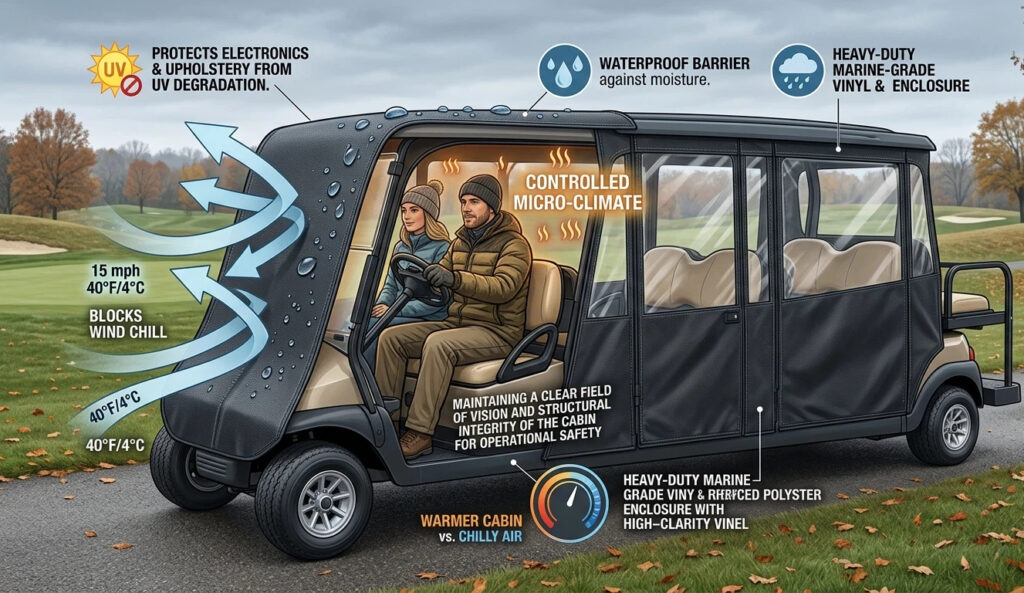
Auf Widerstandsfähigkeit ausgelegt: Wasserdichte 4-Personen-Golfwagenabdeckungen für den Winter
For families or transport fleets, selecting waterproof 4-passenger golf cart covers for winter requires attention to material science. Not all “waterproof” fabrics are created equal. Look for denier ratings of 600D or higher, which indicate a high-density weave capable of resisting tears from ice or frozen debris.
The “Cold-Crack” rating is the most critical technical spec for winter use. Premium Golf cart enclosures utilize vinyl windows treated to withstand temperatures as low as -10°F without becoming brittle or cracking. If you frequently encounter heavy snow or sleet, a “sloped roof” design in your enclosure helps prevent water pooling, which can lead to material stretching and eventual leakage.
So installieren Sie Golfwagengehäuse: Effizienz und Einhaltung gesetzlicher Vorschriften
Most modern systems utilize either a “slip-on” (Over-the-Top) method or a “track-mounted” system. Slip-on models are ideal for seasonal users as they require no permanent modification to the vehicle’s frame.
Der DIY-Installationsprozess:
1.Vorbereitung: Hängen Sie das Gehäuse über das Dach, damit sich das Material 20 Minuten lang in der Sonne „entspannen“ kann. Dadurch wird das Vinyl biegsamer.
2.Ausrichtung: Befestigen Sie zuerst den vorderen Windschutzscheibenabschnitt, um sicherzustellen, dass Ihre Sichtlinie zentriert ist.
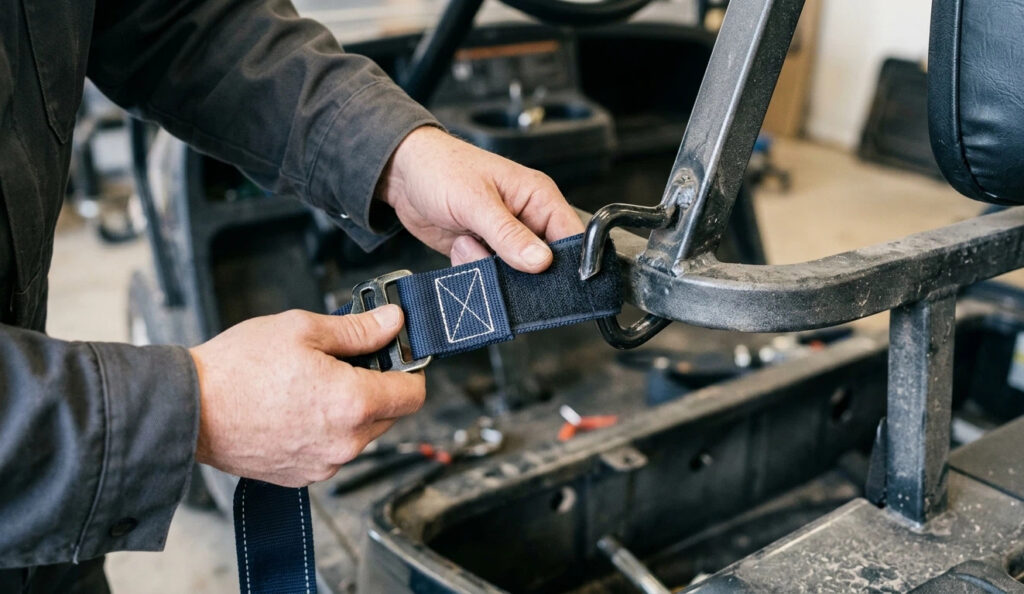
3.Sichern: Benutzen Sie die integrierten Haken oder Klettbänder, um die Seitenteile gegen die Kotflügel zu spannen.
Rechtlicher Hinweis zu DIY-Modifikationen: When you execute a golf cart enclosure installation, you must remain compliant with local Low-Speed Vehicle (LSV) regulations. In states like Florida and California, if your cart is “street-legal,” your enclosure must not obstruct side-view mirrors, turn signals, or brake lights. Many DIYers accidentally cover their reflectors or lights, which can lead to citations. Always ensure your transparent panels allow for 360-degree visibility as required by Department of Transportation (DOT) standards.
Tragbare Golfwagen-Heizungen: Synergie der Wärme in einer Golfwagen-Winterhütte
An enclosure blocks the wind, but it doesn’t generate heat. To achieve true cabin comfort, many owners pair their golf cart winter enclosure with portable golf cart heaters. There are two primary types: propane-powered (cup holder style) and electric-powered (wired to the battery).
While a golf cart winter enclosure is excellent at trapping heat, safety is vital. Propane heaters require adequate ventilation to prevent carbon monoxide buildup. Ensure your Golf cart enclosures have zippered vents or leave a small gap at the bottom of the door to allow for fresh air exchange. For electric carts, a 48V-to-12V reducer is often necessary to prevent the heater from draining specific battery cells unevenly.
Sichtbarkeit und Haltbarkeit: Schützen Sie Ihr Gehäuse vor UV-Strahlung und Eis
The longevity of Golf cart enclosures depends heavily on how you treat the clear vinyl windows. Standard glass cleaners often contain ammonia, which can cause vinyl to yellow and become hazy over time. Instead, use a specialized “plastic cleaner and polish” to maintain optical clarity.
During the winter, avoid using scrapers on the windows of your Golf cart enclosures. If ice builds up, use lukewarm water or a specialized de-icer spray. When the season ends, ensure the enclosure is 100% dry before folding; storing a damp golf cart winter enclosure will lead to mold and permanent staining of the transparent panels.
Letzte Gedanken
The decision to invest in Golf cart enclosures ultimately comes down to your local climate and how often you rely on your vehicle. For those in high-moisture areas, prioritizing waterproof 4-passenger golf cart covers for winter with heat-sealed seams will provide the best long-term ROI.
If you prefer a hands-on approach, mastering the golf cart enclosure installation yourself allows you to adapt the vehicle to changing weather patterns quickly. By combining a high-quality golf cart winter enclosure with safe heating practices and legal compliance, you can enjoy the freedom of your cart 365 days a year, regardless of what the forecast says.
Perguntas frequentes
Passt ein 4-Personen-Gehäuse in meinen 2-Personen-Wagen?
Generally, no. Golf cart enclosures are sized specifically to the roof length. A 4-passenger cart has an extended roof; using that cover on a 2-passenger cart will result in excess material that can get caught in the wheels.
Wie lange dauert die typische Installation eines Golfwagen-Gehäuses?
Bei einem „Over-the-Top“-Modell dauert die Erstinstallation etwa 20–30 Minuten. Sobald Sie mit den Gurtpositionen vertraut sind, dauert es normalerweise weniger als 10 Minuten.