
You see them everywhere in master-planned communities from Florida to California: sleek, quiet, open-air machines humming down the road. But for many owners, there is a looming legal question that only surfaces when a blue light appears in the rearview mirror or an insurance claim is denied. Is your ride a simple golf cart, or is it a true Neighborhood Electric Vehicle?
The distinction isn’t just about semantics or how much you paid. It is a fundamental difference in legal classification, safety engineering, and where you are allowed to drive. If you are a buyer looking for a 25 mph electric vehicle that can legally navigate public streets, buying a glorified golf cart is an expensive mistake.
Sommario
Cosa definisce effettivamente un veicolo elettrico di quartiere ai sensi della legge federale?
In the United States, a Neighborhood Electric Vehicle is a specific category of transport. While the term is often used interchangeably with “golf cart” by salesmen, the federal government sees things differently. According to the National Highway Traffic Safety Administration (NHTSA), an NEV falls under the broader umbrella of Low-Speed Vehicles (LSVs).
To be classified as a Neighborhood Electric Vehicle, the machine must be a four-wheeled motor vehicle whose top speed is greater than 20 mph but not more than 25 mph. This speed range is the “legal sweet spot.” If it goes slower than 20 mph, it is generally considered a golf cart (equipment). If it is designed to go faster than 25 mph, it must meet much more stringent full-scale passenger car safety standards.
Understanding Street legal neighborhood electric vehicle laws starts with recognizing that an NEV is a “motor vehicle” in the eyes of the law, whereas a golf cart is often classified as “recreational equipment.”
La linea da 25 miglia orarie: perché la velocità è importante per il DMV
For many buyers, speed is the primary motivator. You want to keep up with local traffic on 35 mph residential roads. However, there is a hard technical ceiling. A Neighborhood Electric Vehicle is federally capped at 25 mph because that is the limit for the safety testing it undergoes.
When conducting a NEV vs golf cart comparison, look at the speedometer. Most standard golf carts are governed at 14.9 mph. Attempting to “mod” a golf cart to reach 25 mph does not magically turn it into an NEV. In fact, it often makes the vehicle illegal and unsafe, as the braking and steering systems were never designed for those velocities.
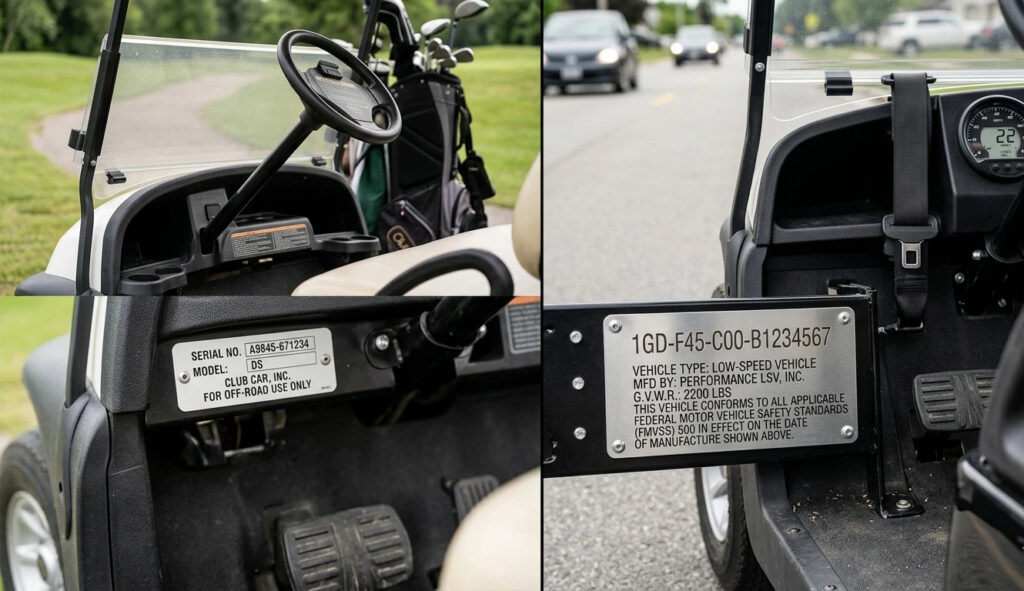
A true 25 mph electric vehicle comes from the factory with a Manufacturer’s Certificate of Origin (MCO) that explicitly states the vehicle meets federal LSV standards. Without this document, your local DMV will likely refuse to issue a title or license plate.
FMVSS 500: gli standard di sicurezza che non puoi ignorare
Why is one allowed on the road and the other restricted to the fairway? The answer lies in Federal Motor Vehicle Safety Standard No. 500 (49 CFR 571.500). This is the “bible” for Street legal neighborhood electric vehicle laws.
Qualsiasi veicolo elettrico di vicinato prodotto per l'uso su strade pubbliche deve, per legge, essere dotato di specifiche caratteristiche di sicurezza. Questi non sono accessori opzionali; sono requisiti federali:
- Fari e fanali posteriori
- Indicatori di direzione anteriori e posteriori
- Luci di arresto (luci dei freni)
- Catarifrangenti (uno rosso su ciascun lato/posteriore)
- Specchietti retrovisori (interno e lato conducente)
- Freno di stazionamento
- Parabrezza (conforme agli standard AS-1 o AS-4 per vetri a base di petrolio)
- VIN (numero di identificazione del veicolo) a 17 cifre
- Cinture di sicurezza (Tipo 1 o Tipo 2)
Se al tuo veicolo manca anche uno solo di questi, non è un Veicolo Elettrico di Vicinato a norma. È possibile visualizzare il testo legale completo di questi requisiti all'indirizzo Ufficio editoriale governativo (titolo 49 del CFR).
IL VIN a 17 cifre: La prova definitiva della “via legale”.
The most reliable way to tell if you own a Neighborhood Electric Vehicle or just a fancy golf cart is to look for the VIN. A standard golf cart has a serial number. A street-legal NEV has a 17-digit Vehicle Identification Number, exactly like a Ford or a Tesla.
Questo codice di 17 cifre è la chiave di tutto. Ti permette di:
- Registra il veicolo presso il Dipartimento dei veicoli a motore del tuo stato.
- Procurarsi la targa, obbligatoria per la circolazione su strade pubbliche.
- Assicurazione automobilistica sicura, spesso richiesta dalla legge per gli LSV ma non sempre disponibile per i semplici carrelli.
When researching how to source high-quality Cr12MoV components for high-stress machinery, engineers look for certifications. Similarly, a savvy buyer looks for the VIN plate. If a dealer tells you a cart is “street-ready” but it doesn’t have a 17-digit VIN, walk away. You are looking at a golf cart that may be illegal the moment its tires touch public asphalt.
NEV contro Carrello da golf: Esplorare il divario prestazionale
Al di là degli aspetti legali, c’è un enorme divario ingegneristico. Poiché un veicolo elettrico di quartiere è costruito per gestire 25 miglia orarie su strade condivise con i SUV, il telaio è generalmente più robusto.
In a NEV vs golf cart showdown, you will notice the NEV usually features better suspension, often automotive-style A-arms, and superior braking—frequently four-wheel hydraulic disc brakes. Standard golf carts often rely on simple mechanical drum brakes on the rear wheels only. If you are driving at 25 mph and a car pulls out in front of you, those four-wheel discs aren’t just a luxury; they are a necessity.
Furthermore, the Cr12MoV properties found in industrial tool steel ensure longevity in high-stress environments. Likewise, the materials used in NEV drivetrains are designed for constant road use rather than the intermittent stop-and-go of a golf course.
Navigazione nelle leggi locali legali sui veicoli elettrici di quartiere
Mentre la legge federale (FMVSS 500) impone come deve essere un NEV costruito, le leggi statali e locali stabiliscono dove può essere guidato. In generale, la maggior parte degli stati consente ai veicoli elettrici del vicinato di circolare su strade dove il limite di velocità indicato è di 35 miglia orarie o meno.
However, some local municipalities are stricter. For example, some beach towns in Florida have specific “LSV-only” zones, while others may ban them from certain high-traffic corridors even if the limit is 30 mph. Always check your local city ordinances. The “street legal” tag from a manufacturer means the vehicle Potere essere registrato, ma non ti garantisce un pass "guida ovunque".
Fare riferimento all'Insurance Institute for Highway Safety (IIHS) per un'analisi stato per stato di come questi veicoli sono regolamentati sulle strade locali.
La realtà assicurativa: proteggere il tuo investimento
Another area where the Neighborhood Electric Vehicle differs from the golf cart is insurance. Because an NEV is a registered motor vehicle, you cannot simply add it to your homeowner’s insurance as a “recreational toy” and expect full coverage for a road accident.
Most states require a Neighborhood Electric Vehicle to carry Personal Injury Protection (PIP) and Property Damage Liability (PDL). If you are involved in a collision with a standard car, having an automotive-grade insurance policy is the only thing protecting you from personal liability. Many insurance carriers have specific “Low-Speed Vehicle” policies designed specifically for this category.
Perché gli amanti della velocità non dovrebbero mai “accontentarsi” di un carrello
For the buyer who wants performance, the Neighborhood Electric Vehicle is the only logical choice. Trying to “overclock” a golf cart is a recipe for mechanical failure and legal headaches. A factory-built LSV/NEV offers a level of stability and power that a cart cannot match.
Whether it is the upgraded AC motor controllers or the high-capacity lithium battery packs, a Neighborhood Electric Vehicle is engineered to maintain 25 mph even with four passengers and a trunk full of groceries. It is the difference between a tool built for a specific job and a toy pushed beyond its limits.
Conclusione
La scelta tra un carrello da golf e un veicolo elettrico di quartiere si riduce a una cosa: l'uso previsto. Se hai intenzione di strisciare solo su un fairway o sulla tua proprietà privata, un carrello da golf è sufficiente.
But if your lifestyle involves public roads, school drop-offs, or trips to the local market, the Neighborhood Electric Vehicle is the only choice that offers legal protection and automotive safety. Don’t be fooled by “street-ready” marketing. Look for the VIN, check the 25 mph limit, and ensure the vehicle meets the FMVSS 500 standard.
Quando investi in un vero veicolo elettrico di vicinato, non stai semplicemente acquistando un passaggio, stai acquistando la libertà di utilizzare la strada legalmente e in sicurezza.
Still debating whether a standard golf cart or a street-legal LSV is right for your needs? Our technical team specializes in navigating the complexities of NEV regulations and can help you select a vehicle that is 100% compliant with federal safety standards.
Domande frequenti
Un veicolo elettrico di quartiere è uguale a un LSV?
SÌ. In termini legali sono la stessa cosa. NEV è il nome comune utilizzato dai consumatori, mentre LSV (Low-Speed Vehicle) è il termine utilizzato dal Dipartimento dei trasporti.
Posso guidare un carrello da golf su strada se aggiungo i paraocchi?
Non necessariamente. A meno che il veicolo non abbia un VIN di 17 cifre e un certificato di origine del produttore che attesti che è conforme a FMVSS 500, l'aggiunta di luci non lo rende un veicolo elettrico di vicinato legale.
Ho bisogno di una patente di guida per un NEV?
SÌ. Poiché si tratta di un veicolo a motore immatricolato, è necessario disporre di una patente di guida valida per guidarlo su qualsiasi strada pubblica.
Qual è la velocità massima di un veicolo elettrico di quartiere?
Secondo la legge federale, la velocità deve essere limitata a 25 mph.
Un NEV può circolare in autostrada?
No. Sono severamente vietati sulle autostrade o su qualsiasi strada con un limite di velocità solitamente superiore a 35 o 45 mph (a seconda dello stato).