You know the feeling: you’re at the base of a moderate incline with a cart full of gear or family, and your vehicle groans to a crawl. Most owners assume the batteries are dying or the motor is weak. In reality, the culprit is often the factory-installed “brains” of the machine. The stock golf cart speed controller is typically engineered for the lowest common denominator—prioritizing liability and battery protection over raw performance and uphill grunt.
For DIY enthusiasts looking to transform their ride from a neighborhood cruiser into a high-performance machine, understanding the golf cart speed controller is the first step. It is the gatekeeper of energy, determining exactly how much amperage reaches your motor and how that power is delivered through the throttle curve.
Sommario
La fisica della potenza: perché gli amplificatori sono importanti per la coppia
To understand why a stock golf cart speed controller fails on hills, we have to look at the relationship between Amps and Torque. In a DC or AC electric motor system, torque is directly proportional to the current (Amperage) supplied. While voltage roughly equates to top speed, amperage provides the “muscle” to move weight.
Factory controllers are often limited to 225A or 250A. When you hit a hill, the motor demands more current to maintain its RPM. If the golf cart speed controller caps that current, your speed drops. Upgrading to a 400A or 500A unit doesn’t necessarily mean you’ll go faster on flat ground, but it means you won’t slow down when the terrain gets tough.
Come osservato nel portale di ingegneria elettrica dell’IEEE, la gestione di correnti elevate richiede una solida gestione termica per prevenire il “ritaglio termico” spesso riscontrato nelle unità più economiche. Puoi leggere di più a riguardo Gestione termica nell'elettronica di potenza tramite IEEE.
Sinergia: associazione del controller con un aggiornamento del motore ad alta velocità
If your goal isn’t just climbing hills but also increasing your top-end velocity, you are likely looking at a high-speed motor upgrade. However, installing a high-speed motor without upgrading your golf cart speed controller is a recipe for disappointment.
A high-speed motor is wound differently to achieve higher RPMs, but these windings often require a higher “turn-on” current to reach their peak efficiency. If you stay with a stock golf cart speed controller, you might actually find that you lose low-end torque in exchange for a few extra MPH on flat pavement.
When you combine a high-speed motor upgrade with a programmable controller, you gain the ability to feed that hungry motor exactly what it needs at every point of the RPM range. This synergy ensures that you don’t just go fast—you get to that top speed quickly.
Come programmare il controller del carrello da golf per una maggiore coppia
This is where the DIY magic happens. Most modern aftermarket units from brands like Alltrax or Navitas offer Bluetooth or USB interfaces. If you want to know how to program golf cart controller for more torque, you need to focus on three specific parameters:
1.Limite corrente di picco: Aumentalo fino al valore massimo di sicurezza del tuo motore (spesso 400 A-500 A per brevi raffiche). Ciò fornisce lo "scatto" quando si preme il pedale.
2. Velocità di aumento dell'acceleratore: Ciò determina la velocità con cui il controller aumenta la potenza. Impostalo troppo in alto e farai un'impennata o spezzerai un asse; impostalo nel modo giusto e otterrai una risposta immediata.
3.Amplificazione corrente: Alcuni controller consentono una modalità "Boost" che fornisce un amperaggio extra specificatamente a bassi regimi (0-500 giri/min), che è esattamente ciò di cui hai bisogno per le partenze in salita.
Navigare nella linea rossa legale sulle strade pubbliche
Before you dial in your golf cart speed controller to hit 30 MPH, you must understand the legal landscape. In many jurisdictions, the moment a golf cart exceeds 20 MPH, it ceases to be a “golf cart” in the eyes of the law and becomes a Low-Speed Vehicle (LSV).
Upgrading your golf cart speed controller gives you the power to break these limits easily. However, operating a modified cart on public streets requires specific safety equipment like turn signals, mirrors, and often a VIN. For a deep dive into the regulations of driving a golf cart on public roads, including the distinction between standard carts and LSVs, check out this comprehensive guide on requisiti legali per i golf cart.
Smart builders often program their “Street Mode” to a hard cap of 19.9 MPH to stay within the legal “Golf Cart” definition while saving the “Off-Road Mode” for private property where they can utilize the full potential of their high-speed motor upgrade.
L'impatto dei controller ad alte prestazioni sulla longevità del motore
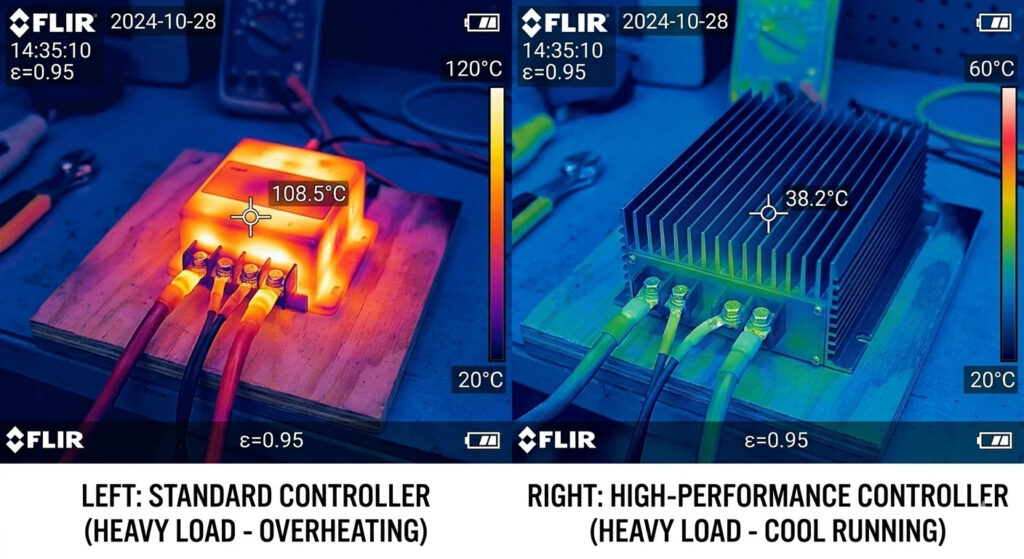
Non c'è pranzo gratis in fisica. Quando si utilizza un controller di velocità del carrello da golf per spingere più corrente attraverso un motore, si genera calore. Questa è nota come perdita $I^2R$ (resistenza attuale al quadrato).
If you frequently utilize the “extreme” settings of your how to program golf cart controller for more torque session, you are subjecting the motor’s internal windings to higher temperatures. Over time, excessive heat breaks down the varnish insulation on the copper wires, leading to a short circuit and motor failure.
Per proteggere il tuo investimento:
- Installare un sensore di temperatura: I controller di fascia alta possono ridurre la potenza se il motore diventa troppo caldo.
- Aggiorna i tuoi cavi: Un controller di velocità per carrello da golf da 500 A è inutile se è soffocato da minuscoli cavi di fabbrica calibro 6. Passa ai cavi di saldatura calibro 2 o calibro 4.
- Ventilazione: Assicurarsi che il dissipatore di calore del controller abbia accesso al flusso d'aria.
Consigli hardware: Alltrax vs Navitas vs Curtis
La scelta del giusto controller di velocità del carrello da golf dipende dal tuo livello di comfort tecnico.
- Alltrax (la scelta dell'esperto): Noto per la programmazione incredibilmente approfondita basata su PC. Se vuoi essere ossessionato da ogni milliampere e curva dell'acceleratore, questo è il gold standard.
- Navitas (Il re facile da usare): Offre un programmatore "On-The-Fly" (OTF), una manopola fisica che puoi montare sul cruscotto per regolare velocità, coppia e frenata rigenerante in tempo reale.
- Curtis (lo standard OEM): Affidabile e robusto, ma spesso richiede programmatori portatili specializzati (e costosi) per sbloccare le modalità di prestazione.
La linea di fondo
Upgrading your golf cart speed controller is the single most effective way to improve your vehicle’s drivability. By understanding how to program golf cart controller for more torque, you can tailor the machine to your specific environment—whether that’s a hilly golf course or a gated community.
Just remember: with great power comes the need for better cooling and a clear understanding of the law. Keep your heat in check, stay under the 20 MPH limit on public asphalt, and your upgraded cart will provide years of high-performance service.
Domande frequenti
Un controller da 500 A farà andare più veloce il mio carrello?
Non necessariamente su terreno pianeggiante. Fornisce più coppia per le salite e l'accelerazione. La velocità massima è regolata maggiormente dai limiti di tensione e giri/min del motore.
Posso utilizzare il mio motore di serie con un controller di velocità per carrello da golf ad alto amperaggio?
Sì, ma devi stare attento. Inserire 500 A in un motore di serie progettato per 250 A per lunghi periodi alla fine lo brucerà. Utilizzare la programmazione del controller per impostare un limite sicuro di "corrente massima".
L’aumento della coppia riduce l’autonomia della batteria?
SÌ. La coppia richiede l'amperaggio e l'amperaggio deriva dalla capacità della batteria. Se guidi in modo aggressivo utilizzando il nuovo aggiornamento del motore ad alta velocità, aspettati un calo dell'autonomia del 10-20%.
È difficile installare un controller di velocità per carrello da golf aftermarket?
Most modern kits are “plug and play” with specific wiring harnesses for Club Car, EZGO, and Yamaha. However, you should always disconnect your batteries and set the Tow/Run switch to “Tow” before starting.