Un chariot 2+2 est un outil d'itinéraire, pas seulement un nombre de sièges
A 2+2 electric golf cart is most useful when the property needs slightly more flexibility than a strict two-seater but does not want the length and staging demands of a larger shuttle. That sweet spot shows up in resorts, golf communities, private clubs, villa properties, and mixed guest-service routes where the cart often carries two to four people, a few small bags, or a guide plus visitors. Buyers who document that real operating pattern usually make better decisions through Voiturette de golf électrique classique, Chariot de golf électrique VY-A2+2, et Demander un devis que les acheteurs qui magasinent par siège comptent uniquement.
The main advantage of a 2+2 layout is balance. It stays compact enough for tighter internal roads and curbside stops while still absorbing the occasional family group, guest luggage run, or property-tour assignment that would strain a smaller cart. That balance is why route mapping matters more than brochure range. A category overview like fond de voiturette de golf est utile pour la terminologie, mais la décision d'achat réelle doit commencer par l'endroit où le chariot attend, la manière dont les passagers montent à bord et la fréquence à laquelle les sièges arrière sont réellement occupés.
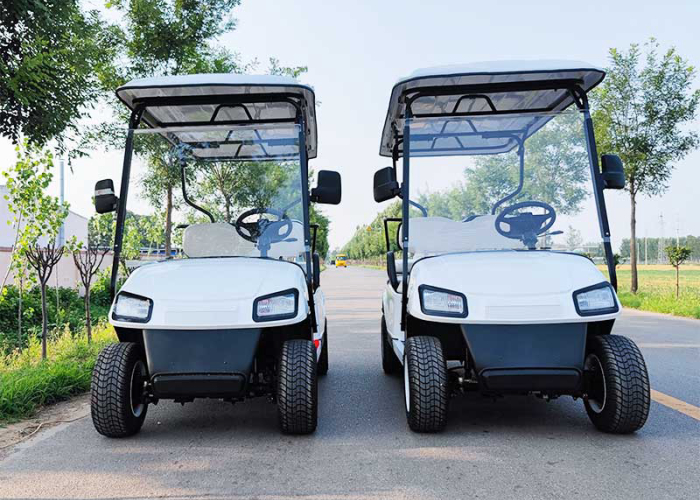
This article is aimed at buyers who want practical questions they can answer before they request a quote. It focuses on guest luggage movement, community mobility, property tours, charging habits, and the difference between a cart that fits the stop pattern and one that merely looks plausible online. The supporting pages at Produits pour voiturettes de golf électriques, Solution de voiturette de golf, et Voiturette de golf électrique Blog sont des références internes utiles lorsque l'équipe souhaite comparer cette disposition avec d'autres rôles de passager sur le même site.
Commencez par le comportement à l'embarquement et la réalité des bagages
A 2+2 cart should first be judged by how easily passengers enter and leave it during a normal stop. If the cart carries club members to a practice area, residents between community amenities, or guests with light luggage to villas, boarding speed will matter more than a feature sheet. Buyers should note step height, whether riders need help, how much time each stop actually takes, and where small bags are placed so they do not block the rear seat or the driver’s line of sight.
The rear-facing seats can be a real advantage, but only when the property knows how they will be used. Some sites need them on almost every trip. Others only need them during arrival peaks, short group transfers, or guided loops. That difference changes whether a 2+2 is the ideal fit or merely a compromise. If the rear seats are occupied continuously, a longer passenger cart may deserve review. If they are used selectively, the 2+2 format often delivers the cleanest mix of utility and maneuverability.
Turning behavior belongs in the same review. Many buyers choose a 2+2 because it is easier to manage at villa drop points, clubhouse entrances, community stops, and landscaped internal roads. That advantage disappears if the route still forces awkward reversing or rushed unloading next to pedestrians. Safety references such as Voiturette de golf CPSC et guide de sécurité LSV, Guidage des véhicules à basse vitesse de la NHTSA, et 49 CFR 571.500 aider à formuler ces questions lorsque le tracé touche des passages à niveau communautaires ou des limites de propriétés adjacentes à la route.
| Transfert des bagages des invités | Plate-forme compacte, déchargement aisé, manutention des sacs légers, accès facile aux places arrière. |
| Mobilité communautaire | Embarquement prévisible, freinage en douceur, rétroviseurs clairs, retour simple du chargeur. |
| Itinéraire de visite de la propriété | Confort à basse vitesse, conversation facile, apparence épurée, cadence d'arrêt fiable. |
| Service mixte court terme | Sièges flexibles avec une profondeur de stationnement pratique et une remise reproductible. |
The boarding area itself is often the hidden bottleneck. Some properties discover that the travel distance is easy but the stop takes too long because riders gather in the wrong place, bags pile up beside the step, or the driver has nowhere calm to wait. When those details are documented before ordering, the supplier can recommend a more realistic configuration instead of guessing from a generic use case.
La batterie et la charge doivent correspondre à des cycles de service courts et visibles
Many 2+2 carts work in bursts. A resort may use one intensely at check-in, then lightly during the afternoon, then again for evening transfers. A club may dispatch the same vehicle repeatedly for short loops across the property. That stop-start rhythm means charging discipline matters as much as nominal range. The cart should return to a predictable bay, be plugged in the same way every time, and have one clear owner during each shift.
Lithium systems are often attractive in this situation because they simplify daily charging and keep performance predictable across repeated short trips. Even so, the benefit depends on charger placement, cable management, and staff habits. Public background from Présentation de la charge de Battery University, Bases de recharge du DOE américain, et Conseils de chargement de la batterie OSHA est utile car cela aide l’équipe à traiter la zone de chargement comme faisant partie de la routine opérationnelle plutôt que comme une réflexion technique cachée après coup.
Short routes also make parking behavior important. If the cart returns to a random place after every trip, it will eventually miss a charging window or block a walkway when staff are in a hurry. A better system gives the driver one obvious return point, one charger routine, and one quick visual check. Those simple habits usually do more for uptime than another accessory package because they make the cart dependable under real operating pressure.
A property that expects a 2+2 cart to cover several different jobs in one day should test whether the charging routine still works when the busiest window hits. If the cart is late because nobody plugged it in, or if the charger area is too awkward for quick turnaround, the route has a systems problem. Fixing that before purchase or rollout is much cheaper than blaming the vehicle once the service routine is already public-facing.
Le confort, l’accessibilité et les règles de conduite façonnent la confiance des passagers
A compact passenger cart still needs to feel calm and stable. Passengers notice step height, roof coverage, handholds, seat support, and how smoothly the cart starts and stops. Those details matter because the same vehicle may carry older guests, community residents, club members, or visitors who are not used to riding in a golf cart at all. A route that looks operationally simple can still feel poor to riders if the cart is hard to board or too abrupt at stops.
Luggage handling deserves its own review. A 2+2 cart can work well for small bags, golf accessories, or light personal items, but the buyer should define that expectation clearly. If staff regularly try to stack bulky luggage or awkward equipment into a compact passenger cart, the stop becomes slow and the route feels messy. That is not a reason to reject the 2+2 concept, but it is a reason to define what the cart is and is not expected to carry.
Accessibility awareness belongs in the route plan too. A property does not need every rider to have the same mobility profile to benefit from better boarding logic, calmer waiting space, and clearer stop rules. The guidance at Conseils pour les appareils de mobilité ADA est un rappel utile que la planification de la mobilité fait partie de la qualité du service. Il en va de même pour les points de sécurité des espaces partagés de Ressources du CDC sur la sécurité des véhicules automobiles et contexte général à faible vitesse de fond de véhicule à basse vitesse.
Driver instructions matter just as much as the hardware. Staff should know where the cart may wait, how to approach pedestrians, when to help riders with bags, and when the vehicle needs a quick clean-down before returning to a guest-facing route. Those rules are what turn a useful layout into a reliable service tool instead of an improvised people mover.
Utilisez des questions d'approvisionnement qui exposent l'adéquation à long terme
Une demande de devis utile doit décrire la longueur de l'itinéraire, le nombre typique de passagers, la configuration des bagages, l'espacement des arrêts, le climat et le lieu de recharge. Cela permet au fournisseur d'expliquer si Chariot de golf électrique VY-A2+2 est le meilleur point de départ, qu'il s'agisse d'une autre disposition à l'intérieur Produits pour voiturettes de golf électriques makes more sense, and which accessories are genuinely helpful. Buyers who only ask for a four-passenger electric golf cart usually receive broad answers because the supplier has to guess what the daily route actually looks like.
Support questions matter as much as route questions. Ask which wear items are commonly stocked, what charger guidance is included, how service documentation is delivered, and how the cart should be staged if a braking or charging issue appears. General references such as Aperçu des normes ANSI, Normes et engagement UL, et Ressources de la NFPA sur la sécurité des véhicules électriques sont des informations utiles car elles maintiennent la conversation centrée sur la discipline des composants et le fonctionnement reproductible plutôt que sur de larges promesses marketing.
Presentation should be considered only after the route logic is clear. A 2+2 cart is often visible at villas, clubs, and community stops, so finish quality and accessory choices do matter. Still, appearance should follow boarding fit, charger discipline, and service convenience rather than replacing them. A cart that looks elegant in a still photo but feels awkward at the curb is not the right purchase.
Créez une liste de contrôle d'acceptation simple avant que le chariot n'entre en service quotidien
Before the cart becomes part of a visible route, the property should create a short acceptance checklist covering real use rather than only delivery condition. Test full-load braking on the steepest section, confirm rear-seat access with the kinds of riders the property actually serves, and verify that the charger can be reached without crossing a busy walkway. The same checklist should note mirror usefulness, horn access, roof coverage, and whether bags can be managed without slowing every stop.
This acceptance stage is also the right time to decide whether one 2+2 cart can cover all intended tasks or whether the route needs a second vehicle during peak periods. Some sites discover that the compact cart is ideal for guest-facing movement but that housekeeping or maintenance support should stay on a different vehicle. That is valuable information because it protects the guest route from becoming overloaded while still preserving the agility that made the 2+2 format attractive in the first place.
A written acceptance checklist improves the supplier discussion too. Instead of saying the cart feels good or bad, the buyer can explain exactly what happened on the route: how long boarding took, where bags created friction, whether the charger return felt realistic, and which stop required the calmest turning. That level of detail usually leads to a better follow-up decision than another round of generic feature comparison.
Un itinéraire pilote révélera plus que n'importe quelle page de catalogue
If the buyer expects the cart to operate in a visible part of the property, a pilot route is worth the effort. Test the vehicle with realistic passenger weight, the usual small-bag load, repeated boarding, and the actual pickup points used during a busy day. Ask the driver whether the rear seats are truly practical, whether the stop rhythm feels calm, and whether the parking depth still works when people are waiting.
The pilot checklist should include charging behavior, brake feel on the steepest part of the route, mirror usefulness near pedestrians, and how quickly the cart can be reset between visible trips. If the property also uses the cart for tours, confirm that conversation remains comfortable and that the vehicle does not feel rushed or cramped at low speed. Those observations provide much stronger evidence than a brochure line ever could.
Une fois ces notes documentées, la prochaine discussion avec Contact Longshengtai ou Demander un devis becomes much more useful. The supplier can respond to a real route description instead of a vague wish list, and the buyer can decide whether the same configuration should be scaled, adjusted, or paired with another cart type for peak periods.
Référence vidéo
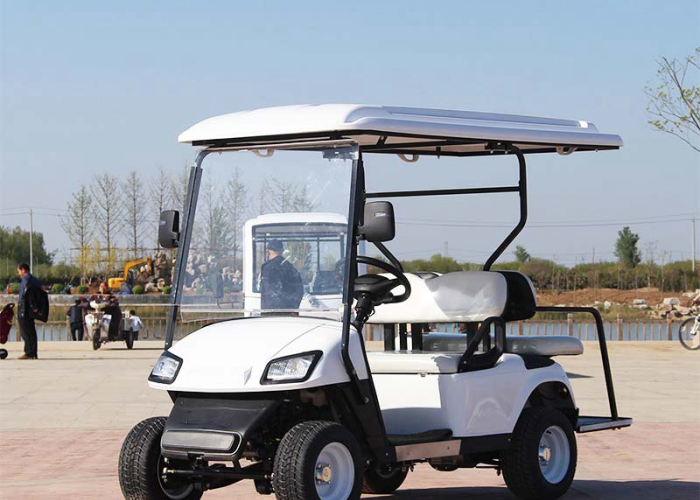
The video below shows a Longshengtai 2+2 electric golf cart in a way that is directly relevant to this buying guide. Use it to support the boarding, route, and charging checklist above rather than to replace your own site review.
Questions que les acheteurs posent souvent
Quand un chariot 2+2 est-il préférable à un chariot navette plus long ?
A 2+2 cart is usually better when the route carries two to four riders on short trips, when parking depth is limited, and when the site values compact handling at pickup points. It is less suitable when larger groups ride on most trips or when bulky luggage is common.
Un chariot 2+2 peut-il bien gérer les bagages des invités ?
Oui, si les bagages sont légers et que la zone d'embarquement est organisée. L'acheteur doit définir quels types de sacs sont normaux, comment ils sont chargés et si l'arrêt semble toujours sûr et calme lorsque l'itinéraire est très fréquenté.
Quelle est la meilleure étape avant de demander un devis ?
Notez l'itinéraire, le nombre de passagers, le modèle de bagages, le lieu de recharge et la fenêtre de service la plus occupée. Une fois ces détails clairs, la discussion à travers Demander un devis devient beaucoup plus précis et beaucoup plus utile.
Vue de la décision finale
The right 2+2 electric golf cart is the one that fits the stop pattern, handles light luggage without drama, and returns to charge on a routine the staff can actually follow. Buyers who document those realities before ordering usually get a better recommendation and a smoother operation after delivery.
When the route, boarding logic, and charger discipline are visible on paper, choosing a compact passenger cart becomes far easier. That is the point where a 2+2 layout turns from a generic category into a practical transport tool.