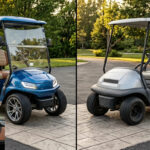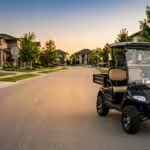
The transition from the fairway to the neighborhood street has transformed local transportation. For many residents in master-planned communities, the appeal of driving a golf cart extends far beyond a weekend game. It has become a primary mode of transport for grocery runs, school drop-offs, and visiting neighbors.
However, driving a golf cart outside private property boundaries introduces a complex web of legal and physical risks. Transitioning into mixed traffic with standard automobiles requires more than just a full battery or a tank of gas. You are stepping into a regulated environment. This guide breaks down the essential legal frameworks, hardware requirements, and safety protocols necessary to expand your travel radius without risking fines or accidents.
Table des matières
Définir le périmètre : où est-ce légal ?
Before driving a golf cart through a municipal intersection, you must understand the distinction between a standard golf cart and a Low-Speed Vehicle (LSV). Local municipalities and federal safety boards treat these two categories very differently.
Le seuil de 35 MPH
Dans la plupart des juridictions des États-Unis, voiturettes de golf and LSVs are strictly prohibited from operating on highways or major arterial roads. The general legal consensus permits operation only on roads where the posted speed limit is 35 mph or lower. Crossing a road with a higher speed limit is sometimes permitted at designated intersections, but traveling along them is a traffic violation.
Classifications fédérales et ordonnances locales
Loi fédérale, en particulier sous la National Highway Traffic Safety Administration (NHTSA), defines an LSV as a four-wheeled vehicle whose top speed is more than 20 mph but not more than 25 mph. Communities like The Villages in Florida serve as a benchmark for local ordinances, successfully integrating miles of multi-modal paths with public streets. However, even in such cart-friendly zones, strict compliance with local street signs and lane restrictions is enforced.
Connaître la classification spécifique du véhicule lorsque vous conduisez une voiturette de golf sur l'asphalte municipal est votre première ligne de défense contre les citations.
La liste de contrôle légale : mises à niveau matérielles critiques
A factory-standard golf cart is designed for grass and private paths. Upgrading your hardware is a prerequisite for driving a golf cart legally on neighborhood streets. You must convert it to meet Department of Transportation (DOT) standards.
Matrice de transformation matérielle
Vous trouverez ci-dessous une ventilation technique comparant l'équipement de cours standard aux exigences légales de rue (LSV).
| Composant | Voiturette de golf standard (utilisation du parcours) | Exigence LSV légale pour la rue (voies publiques) |
| Éclairage | Aucun requis | Phares, feux arrière, feux stop et clignotants. |
| Miroirs | Aucun requis | Rétroviseur extérieur côté conducteur et rétroviseur intérieur ou rétroviseur extérieur passager. |
| Pare-brise | Facultatif (souvent en plastique fin) | Pare-brise incassable certifié AS1 ou AS5 DOT. |
| Contraintes | Aucun | Ceintures de sécurité approuvées par le DOT pour chaque position assise désignée. |
| Réflecteurs | Aucun | Réflecteurs rouges à l'arrière et sur les côtés. |
| NIV/immatriculation | Numéro de série uniquement | Numéro d'identification du véhicule (VIN) à 17 chiffres et plaque d'immatriculation. |
La fabrication de précision est importante
When retrofitting a vehicle, the quality of the installation is just as important as the parts themselves. For instance, manufacturing DOT-approved acrylic windshields requires precision large panel cutting to ensure structural integrity. A poorly cut windshield will rattle under street vibration and may fail to protect occupants from road debris.
Naviguer dans les réglementations de la voie publique et leur conformité
Comprendre les réglementations locales en matière de voirie publique est obligatoire. L'ignorance de la loi n'est jamais une défense acceptable lors d'un contrôle routier ou, pire encore, après un accident.
Licence et restrictions d’âge
A common misconception is that anyone can operate a slow-moving vehicle. In reality, the legal age for driving a golf cart on public streets is heavily regulated. In states with high golf cart usage, such as Florida, operators must possess a valid driver’s license or a restricted learner’s permit. Allowing unlicensed teenagers or children to take the wheel on public roads can result in severe legal penalties for the parents.
La logique de priorité
Conduite sous influence
The consequences of driving a golf cart under the influence of alcohol or drugs are identical to those of a standard automobile. A DUI charge on a golf cart will suspend your primary driver’s license and carry heavy fines. Law enforcement actively patrols cart-friendly communities for this specific violation.
Partager la route
Following the rules for driving a golf cart on public roads goes beyond legal compliance; it requires a defensive mindset. Standard passenger vehicles weigh thousands of pounds more than your cart and have significant blind spots.
La visibilité, c'est la vie
Because your vehicle is smaller and slower, standard car drivers often misjudge your speed or fail to see you entirely. Maintaining visibility while driving a golf cart at night or during heavy rain requires all lighting systems to be fully operational. Use high-visibility reflective tape on the rear bumper as an added precaution.
Positionnement défensif
Stay as far to the right of the roadway as safely possible to allow faster traffic to pass. However, when preparing for a left turn, you must merge into the correct turning lane well in advance. Always use electronic turn signals, supplemented by standard hand signals if you suspect a driver behind you is distracted.
Responsabilité et assurance
La responsabilité financière liée à la conduite d’une voiturette de golf sur la voie publique est un facteur critique souvent négligé par les propriétaires.
Many owners assume their standard Accueilowners Insurance policy will cover accidents. This is a dangerous assumption. Most homeowners policies explicitly exclude liability for incidents that occur off the insured property boundary.
Si votre chariot est classé LSV légal sur route, vous êtes légalement tenu de souscrire une assurance automobile spécifique. En utilisant La Floride rigorous standards as an industry benchmark, registered LSVs must be insured with Personal Injury Protection (PIP) and Property Damage Liability (PDL) coverage. Purchasing a dedicated, standalone golf cart policy ensures you are protected against bodily injury claims, property damage, and uninsured motorists.
Conclusion
Expanding your local travel radius offers incredible convenience and a fun, open-air experience. However, the road demands respect. Ultimately, driving a golf cart in mixed traffic is a serious responsibility. By upgrading your vehicle to meet street-legal standards, securing the proper insurance, and strictly adhering to local traffic laws, you can safely enjoy the neighborhood roads while protecting yourself, your passengers, and your community.
FAQ
Est-il permis de conduire une voiturette de golf sur le trottoir ?
Non. Les trottoirs sont strictement réservés aux piétons, vélos et scooters. Conduire un chariot motorisé sur un trottoir est illégal et très dangereux pour la circulation piétonnière.
Ai-je besoin d’une plaque d’immatriculation pour les routes du quartier ?
Si la route est publique et que votre véhicule répond aux exigences de vitesse et de matériel LSV, il doit être immatriculé, immatriculé et afficher une plaque d'immatriculation visible, tout comme une voiture standard.
Les enfants sont-ils tenus d'utiliser des sièges d'auto dans une voiturette de golf ?
Yes. If the vehicle is operating legally on a public road as an LSV, all standard state child restraint laws apply. Children must be secured in appropriate, DOT-approved car seats strapped into the cart’s seat belts.