
A 48V golf cart should be chosen around the route, not the battery label alone
A 48V electric golf cart is often the practical middle ground for resorts, campuses, communities, parks, hotels, and mixed-property fleets that need predictable daily performance without overcomplicating the charging routine. The mistake is assuming that the voltage number answers every buying question by itself. Buyers still need to review passenger load, route slope, stop frequency, accessory demand, charging window, and whether the cart will stay in one role or gradually take on harder work over time.
For many properties, 48V works because it is familiar, serviceable, and easier to fit into an existing operating habit. A fleet may already have a charging bay, a battery-maintenance routine, and a clear idea of how far each cart travels before the shift ends. That does not mean every 48V cart behaves the same. Controller setting, battery chemistry, vehicle weight, tire choice, and route surface can make two carts with the same nominal voltage feel very different on the same property. That is why a buying discussion should combine product pages such as Electric Golf Cart Products and Golf Cart Solution with a written route review rather than a quick spec comparison.
This guide is written for buyers who need a practical answer to a simple question: when is a 48V electric golf cart the right choice, and what should be checked before a quote is approved? It focuses on real operating decisions instead of showroom shortcuts. Public guidance from U.S. Department of Energy EV and charger overview and Alternative Fuels Data Center electric-vehicle overview helps frame broader electric-vehicle planning, but the final specification still depends on how your own cart is used every day.

Start with the actual daily job before discussing voltage
The first step is to define the normal route. Write down how many passengers or how much gear the cart carries, how many stops are made, whether the route includes ramps or soft surfaces, and how long the cart must stay available before it returns to the charger. A Classic Electric Golf Cart cart used for guest transfers on smooth paths may place very different demands on a 48V system than a A Type Electric Golf Cart cart used by maintenance staff making repeated stop-and-go trips across service lanes. Buyers who skip this route map often blame the battery later for a mismatch that was really caused by unclear fleet planning.
Daily job definition should also include the exceptions, not just the average run. Ask what happens during high-occupancy events, rainy weeks, late checkouts, special maintenance days, or staffing gaps that force one cart to cover two jobs. The route needs to be measured under the conditions that create stress because that is where a voltage decision starts to matter. Safety material from CPSC golf cart and LSV safety guide and site-risk references from CDC motor vehicle safety resources are useful reminders that passenger behavior, route conflict, and operating discipline affect performance just as much as the battery pack does.
A buyer should also decide whether the cart is a stable single-purpose asset or a flexible shared unit. Shared units often need more operating reserve because they are borrowed for errands that were never written into the original plan. If the cart may become a general-use property vehicle, say so in the request through Request a Quote. That one sentence can change how the supplier recommends seat layout, battery type, accessory power, and daily charging routine.
| Route question | Why it matters for a 48V decision |
| How long is the normal shift? | Determines whether overnight charging is enough or whether turnaround reserve is needed. |
| How heavy is the usual load? | Affects acceleration, hill response, and usable range more than voltage labels suggest. |
| How often does the cart stop? | Frequent starts and short moves increase energy use and heat differently from steady loops. |
| Is the cart shared between teams? | Shared duty usually needs a bigger margin for misuse, accessories, and delayed charging. |
Understand what 48V tells you and what it does not
A 48V label is useful, but it is only one part of the system. Buyers should ask about battery capacity, chemistry, controller behavior, motor match, charger output, and the weight of the final configuration. A 48V cart with a well-matched lithium pack may feel more responsive and easier to manage than a poorly maintained lead-acid setup with the same nominal voltage. Technical charging background from Battery University charging overview is helpful because it explains why charging behavior and battery care influence usable performance over the whole life of the cart, not only on delivery day.
Voltage also does not tell you how sensible the route assignment is. Some fleets buy by headline numbers and then expect one cart to serve guest movement in the morning, cargo movement at noon, and event support at night. The result is often inconsistent charging discipline and unclear driver expectations. If the site needs that kind of flexibility, the discussion should include the Electric Golf Cart Blog archive, the product-category pages such as B Type Golf Cart and D Type Electric Golf Cart, and a clear note about what the cart must still do near the end of the shift when battery reserve is lower.
In other words, 48V should be treated as an operating platform, not as a marketing answer. Standards context from ANSI standards overview, product-evaluation references from UL Standards and Engagement, and local service habits all matter because the best system is the one the property can charge correctly, inspect consistently, and support without guesswork. That practical fit is often more important than chasing a larger number that the route never truly needs.
Plan the charging area, outlet capacity, and shift rhythm together
A 48V cart works best when the charging area is calm and predictable. The buyer should know where the cart will park, which outlet or charger position belongs to it, how cords are managed, whether the bay stays dry, and who is responsible for plugging in the unit at the end of the route. Charging guidance from U.S. DOE charging basics and workplace battery-safety material from OSHA battery charging guidance are worth reviewing because a simple charging area still needs clear rules around ventilation, cable condition, and housekeeping.
Shift rhythm matters as much as the outlet. A cart used for one long daytime loop can usually follow a different charging plan from a cart that returns repeatedly for short turnaround windows. Buyers should write whether the operation depends on overnight charging only, mid-day opportunity charging, or backup-cart rotation when demand spikes. That detail helps the supplier decide whether the cart needs a straightforward guest-shuttle setup, a more utility-oriented body, or a different battery option linked to pages like Electric Golf Cart Manufacturer and Electric Golf Cart Products.
Do not ignore charger replacement planning either. If the site expects to add more carts later, confirm whether the chargers, plugs, and daily parking layout can scale without confusion. A fleet with mixed charger types or unlabeled bays usually creates avoidable service calls. Even when the current order is small, a short note about future expansion through Contact Longshengtai can help keep the first purchase compatible with the second.
| Charging topic | What to confirm before ordering |
| Parking bay | Enough depth, clear cable routing, and weather protection for the expected body size. |
| Outlet access | Stable power supply and no dependence on improvised extension-cord habits. |
| Turnaround window | Whether the cart can wait for a full charge or needs planned partial top-ups. |
| Expansion path | Whether future carts can use the same charging logic without retraining everyone. |
Choose battery chemistry and upgrade path with the full life cycle in mind
A 48V system can be paired with different battery approaches, and the right choice depends on workload, service discipline, and replacement planning. Some buyers prefer a familiar routine because their staff already knows how to inspect, water, and rotate battery care tasks. Others want a cleaner charging routine and steadier power behavior that aligns better with daily guest service. The correct answer is not ideological. It is operational. Use the existing lithium-focused resources on D Type Electric Golf Cart and VY-D2 Lithium Battery Golf Cart together with your own maintenance notes before deciding what will be easiest to support after the first exciting week of ownership is over.
Upgrade planning should be discussed before the first cart is delivered, not only when the original batteries age. A fleet manager should ask how replacement timing will be handled, which parts are considered normal wear, what documentation is needed for support, and whether the same charger logic will still apply after a battery refresh. Consumer warranty guidance from FTC warranty guidance is general, but it reinforces an important habit: do not leave critical service assumptions unwritten.
The best buying brief explains both the current need and the likely future state. If the property expects longer shifts, more accessories, or a heavier service role later, say so now. That may affect not only battery selection but also the body type, tire choice, and how much electrical reserve is sensible. A modestly specified cart can work very well when its job stays stable. Problems begin when managers quietly expand that job without revisiting the original assumptions.
Match 48V carts to seat count, accessories, and route etiquette
Seat count changes the way a 48V cart should be evaluated. A VY-A4 4 Seater Golf Cart carrying guests on level paved lanes is different from a VY-A6 6 Seater Golf Cart or VY-D4+2 Golf Cart 6 Seater moving more people with more frequent boarding and baggage handling. The bigger the body and the more varied the route, the more important it becomes to review stop spacing, staging discipline, and whether the driver is expected to idle with lights or accessories running while passengers board.
Accessories deserve the same attention. Roofs, windshields, lighting packages, enclosures, USB charging, fans, radios, storage kits, and branding elements all add small demands or alter the way the cart is used. That does not mean accessories are a problem. It means they should be discussed as part of the operating system. The Golf Cart Accessories page is useful for planning these additions, while references such as NHTSA low-speed vehicle guidance help buyers remember that visibility and control equipment matter more than appearance when the cart works around pedestrians or mixed traffic areas.
Route etiquette should be written into training once the cart is selected. Drivers should know how to avoid unnecessary full-throttle starts, when to return the cart for charging, how to report reduced reserve, and what to do if the vehicle is asked to take on a job outside its defined role. That operating clarity often protects battery life and service quality more effectively than any theoretical spec advantage.
Turn the buying brief into a support and verification checklist
Before approving the order, build a short checklist covering route description, seat count, usual load, peak load, shift length, charger location, battery preference, accessory list, spare-parts expectations, and service contact path. This converts a vague request for a 48V cart into a testable operating plan. It also makes the first delivery easier to verify because the property can compare the delivered setup against a written brief instead of relying on memory.
Verification should continue after delivery. Track how far the cart really travels, whether charging habits are easy for staff to follow, whether the route changes during peak periods, and whether operators report lower confidence near the end of the shift. Those notes help determine whether the 48V choice was right, whether the route discipline needs work, or whether the fleet is gradually asking the cart to do more than originally planned.
When that checklist is maintained, a 48V electric golf cart becomes much easier to buy and much easier to manage. The property knows why the cart was chosen, the supplier understands the route, and future expansion decisions can build on real evidence rather than guesswork. That is the practical advantage buyers should aim for.
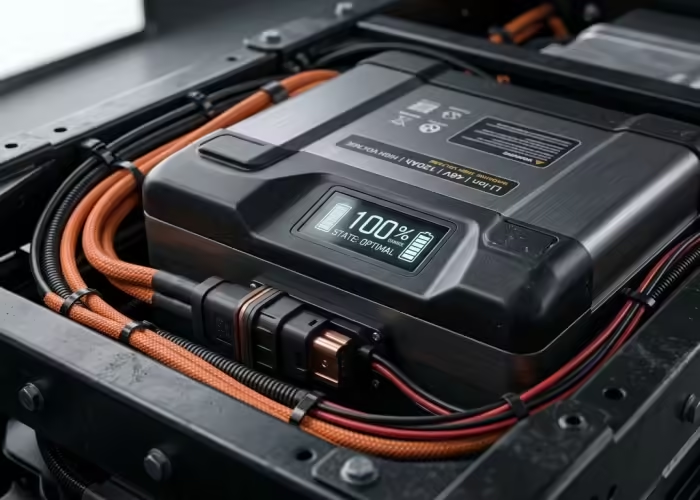
Video reference
The video below offers general visual context for 48V golf cart batteries and charging behavior. Use it as a prompt for questions, then confirm every final battery and charger decision against the exact route and service plan for your fleet.
Questions buyers often ask
Is a 48V electric golf cart enough for commercial property use?
Yes, when the route, passenger load, shift pattern, and charging routine fit the cart’s intended role. The right answer depends less on the voltage label alone and more on whether the property has defined the daily job clearly.
Should buyers plan battery replacement before the first order?
Yes. Replacement timing, support responsibility, charger compatibility, and documentation should be discussed before purchase so the fleet is not forced into guesswork later.
What is the most common 48V buying mistake?
The most common mistake is buying around a broad performance expectation without writing down route length, peak load, accessory demand, and charging windows. That makes it difficult to judge whether the delivered cart actually matches the job.
A good 48V decision is a route decision
A 48V electric golf cart can be an excellent choice when the route is clear, the charging bay is organized, and the buyer defines the real work before asking for a quote.
It becomes a poor choice only when managers expect the voltage label to solve problems that really belong to route planning, shift planning, or battery-care discipline.
If buyers record the route, load, charger setup, and support expectations before ordering, they give both the supplier and their own team a much better chance of getting the fleet right the first time.
That written approach also makes future upgrades calmer because the property can compare new needs against an evidence-based starting point instead of starting over from opinion.